Advertisements
Advertisements
प्रश्न
How did the author react on seeing his photograph?
Advertisements
उत्तर
The author was upset to see his photo. It carried the little likeness of him. He even asked the photographer if it was himself in the photo.
APPEARS IN
संबंधित प्रश्न
Fill in the blank with the suitable word.
Sita’s daughter carried _____________ the family business when Sita went abroad.
You are to be awarded a Special Prize at the Annual Prize Day ceremony of your school. Write a letter to a lady relative, giving her the news. Be sure to include details of the prize that you are to receive, and tell her why you have been chosen for this honour.
Re-write the following sentences according to the instructions given after each. Make other changes that may be necessary, but do not change the meaning of each sentence.
- As soon as we lit the candle, the power supply was restored.
(Begin: No sooner………. ) - The bee is more industrious than all other creatures.
(Use: ‘most industrious’) - The old woman was too slow to catch the bus.
(Begin : The old woman was so……… ) - “I’ll do it tomorrow,” he promised.
(Rewrite in indirect speech) - Though Reema got an expensive gift she was not happy.
(Begin: In spite of……… ) - I prefer reading a book to watching a movie.
(Begin: I would rather…….. ) - I have never seen Mr. Roy lose his temper.
(Begin: Never…….. ) - She found your keys in the garage.
(Begin: The keys……… )
Combine the following sets of ideas to show the contrast between them.
(i) European art tries to achieve a perfect, illusionistic likeness.
(ii)Asian art tries to capture the essence of inner life and spirit.
Distinguish between the following pairs of sentences.
Green and black stripes were used alternately.
The words in the box are all words that describe movement. Use them to fill in the blank in the sentence below.
I saw a cobra ___________ out of a clump of cactus.
Read the words/phrases in the box. With your partner find their meaning in the dictionary.
|
Harsh conditions harmless survive intruder threatened predators prey continually |
Fill in the blanks in the following passage with the above words/phrases.
All animals in forests and deserts struggle to ______________________in ______________
___________________ . Though most of the animals are ___________________, some are
dangerous when _____________________. If an ___________________ is noticed, they attack
or bite to save themselves. They struggle __________________ for food and water.
Some animals are called ______________because they __________________ on other animals.
The extract deals with the atmosphere of two homes. Collect the words associated with - Home.
Write down the significance of the following in the context of ‘On to the Summit’:
Red Scarf
Discuss the following with your partner and complete the following sentence.
Food adulteration means _________________.
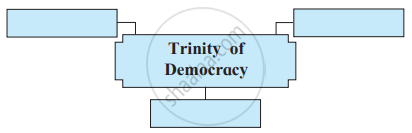
The trinity of democracy comprises three principles. Complete the web to show the trinity of democracy.
Search in your college library or on the internet for at least five stories where a king or any great person has forgiven a losing king, culprit, or offender. There are many such stories that you might have read in your history books. One such story is of Alexander and Porus. Find at least five stories and write their summarised version in your notebook.
Prompt reporting is of strategic importance during a war. Refer to the above extract and explain.
Imagine that you are one of the soldiers from 18 Grenadiers on the mission Tiger Hill. Narrate your experience of the war to your friend.
'Even small things in nature play a big role. So protect nature!'
Draft a short speech on the above topic, which you could give at your school assembly.
Use the following steps while drafting.
- Greeting
- Salutation
- Self - Introduction
- Introduction of the topic
- Body of the Speech
- Conclusion
- Expression of gratitude to audience
Given below is the poem 'Blue Sky' by Mark Hastings. Imagine a poem of a similar kind by replacing the word blue. You can add any colour or object of your choice and write a poem of four lines.

For example, replace 'blue' with
- Starry sky above me _______________
- Cloudy sky above me _____________
A brilliant student from your school has won a Mathematics Quiz at the National Level.
Frame questions to interview him/her when the school felicitates him/her. Follow the steps given below.
- Greetings
- Introduction of the interviewee and achievements.
- 2 or 3 questions about growing years.
- 4 to 6 questions about the achievements.
- 2 or 3 questions about future plans and prospects.
- Expression of thanks and good wishes.
- Read the first three paragraphs on Page 92. (From......... ‘One morning .............. up to ............ a discussion after hall)
- Re-read the same noting down only important points.
- Rewrite the important points in your own simple language, in your notebook.
- Make certain that your summary is less than half the length of the original passage.
Divide the class into groups of 4-6. Each group selects for itself, one of the difficult situations listed below. Each group imagines itself to be in that situation.

(a) marooned on an island
A group of passengers is marooned on an island in the middle of the ocean.
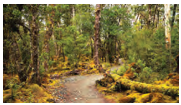
(b) lost in a forest
A group of pilgrims walking through a thick jungle have lost their way.

(c) stranded on the highway
A team of players from an office has got down at the wrong place on a highway at night. It is a lonely spot.
- Describe their surroundings in 4-5 sentences.
- Write the reactions of the companions using exclamations.
- Using your imagination, write what is the only ray of hope for them.
- Two members of the group are going out to try to get help. They can take any five things with them. Write what they choose, and why they choose it.
Use the option to fill in the blank.
The flowers ______kept in a vase.
State whether the following statement are true or false
The cop suddenly slowed his walk, when he heard the barking of dogs.
Read and understand the data presented in the pie-chart below on factors affecting health, and write an article for your school magazine highlighting the fact that it’s our lifestyle that determines how healthy we remain. Write your article in about 150 words. Give a suitable title too.

The factors which affect health are given percentage-wise in the pie chart.
What was the only similarity between Leacock’s face and his photograph?
The poet immortalizes the tree. Elucidate.
Attempt a description of the following process, in about 100 word each, either using the imperative or the passive.
Obtaining a demand draft from a bank
You have recently watched an interesting film. Write a review of this film, in about 200 – 250 words, based on the points given below.
Name of the film and its director – actors in the film – type of film – plot – quality of direction/acting – cinematography/costumes/sets – reaction of audiences – recommended/not recommended
Write an original short story in which two children and their school teacher are the main characters.
When Luz Long said, 'something must be eating you' he meant that Jesse Owens must be ______.
"A Daniel come to judgement! Yea a Daniel" Who is being described in these words? By whom?
Divide the students into groups of five. They sit in a circle. They choose one object of daily use such as a bag, wallet, box, etc. The group leader writes four sentences about it.
- I have found a ______
- It’s (colour)
- It’s (shape)
- It has a ______
- I found it (place where it was found)
Others, too, write four sentences each.
- • I’ve lost a ______
- It’s (colour)
- It’s (shape)
- It has a ______
- • I lost it (place where it was lost)
They all open read their lines, beginning with the group leader. The player whose description matches the group leader’s the most gets the object.
