Advertisements
Advertisements
प्रश्न
Give the steps in PCR or polymerase chain reaction with suitable diagrams.
Advertisements
उत्तर
Polymerase Chain Reaction (PCR) is the process of in vitro amplification of the gene of interest using a PCR machine.
i. PCR can generate a billion copies of the desired segment of DNA or RNA, with high accuracy and specificity, in a few hours.
ii. The process of PCR is completely automated and involves automatic thermal cycles for denaturation and renaturation of double-stranded DNA.
iii. The device required for PCR is called a thermal cycler.
iv. Requirements for polymerase chain reaction:
- DNA containing the desired segment to be amplified
- several molecules of four deoxyribonuclueoside triphosphates (dNTPs)
- excess of two primer molecules
- heat-stable DNA polymerase and
- appropriate quantities of Mg++ ions.
Mechanism of PCR:
At the start of PCR, all the requirements are mixed together in ‘Eppendorf tube’ and the following operations are performed sequentially:
Step i: Denaturation
The reaction mixture is heated to a temperature (90–98oC) to separate two strands of desired DNA. This is called denaturation.
Step ii: Annealing
The mixture is allowed to cool (40–60oC) that permits the pairing of the primer to the complementary sequences in DNA. This step is called annealing.
Step iii: Primer extension / Polymerization
The temperature (70–75°C) allows thermostable Taq DNA polymerase to use single-stranded DNA as a template and adds nucleotides. This is called primer extension. It takes around two minutes duration.
v. One cycle takes around 3 to 4 minutes.
vi. To begin the second cycle, DNA is again heated to convert double-stranded DNA into single strands.
vii. In an automatic thermal cycler, the above three steps are automatically repeated 20-30 times. Thus, at the end of ‘n’ cycles, 2n copies of DNA segments are produced.
viii. The machine performs the entire operations automatically and precisely.
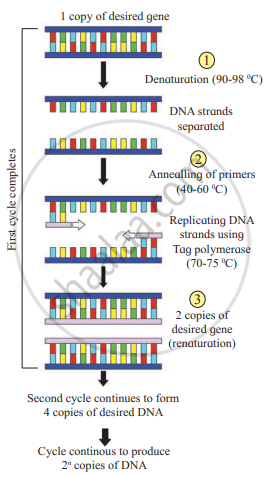
DNA replication through a polymerase chain reaction.
APPEARS IN
संबंधित प्रश्न
Distinguish between RNA and DNA.
How has the development of bioreactor helped in biotechnology?
Identify the properties that a cloning vector must possess to be efficiently used in rDNA technology.
- Control elements like promoter, operator, ribosomal binding sites
- Restriction sites
- Marker genes
- Ori of replication
- Ability to replicate independently
The following identifies the major features of technology that differentiate modem biotechnology from classical biotechnology.
i. Capability of science to change the genetic material for getting new specific products through rDNA technology, polymerase chain reaction (PCR), microarrays, cell culture and fusion, and bioprocessing.
ii. Ownership of technology and its sociopolitical impact.
iii. Modem biotechnology makes use of only fermentation technology.
iv. Classical biotechnology relies only on principles of plant and animal tissue culture.
Which of the following is NOT involved in genetic engineering technique?
i. Combining genes from two organisms
ii. Gene cloning
iii. Transfer of lipid molecules
iv. Transfer of genes to new organisms
v. Repairing or replacing the defective genes by healthy genes
vi. Artificial synthesis of new gene
Human insulin is produced by culturing the genetically engineered ______
Name two restriction enzymes used in PCR.
Identify the desirable characteristics for a plasmid used in rDNA technology from the following.
- Ability to multiply and express outside the host in a bioreactor.
- A highly active promoter.
- A site at which replication can be initiated.
- One or more identifiable marker genes.
- One or more unique restriction sites.
Who accomplished the creation of the first artificial recombinant DNA molecule, and what was linked together?
Restriction enzymes are referred to as 'molecular scissors' because they:
