Advertisements
Advertisements
प्रश्न
Give a simple chemical test to distinguish between the following pair of compounds:
Phenol and Benzoic acid
Advertisements
उत्तर १
Phenol and benzoic acid can be distinguished by ferric chloride test. In the ferric chloride test, phenol reacts with neutral FeCl3 to make an iron-phenol complex that turns violet.
\[\ce{\underset{Phenol}{6C6H5OH} + FeCl3 -> \underset{(Violet colour)}{\underset{Iron-phenol complex}{[Fe(OC6H5)6]^3-}} + 3H+ + 3Cl-}\]
But benzoic acid reacts with neutral FeCl3 to give a buff coloured ppt. of ferric benzoate.
\[\ce{\underset{Benzoic acid}{3C6H5OH} + FeCl3 ->\underset{(Buff coloured ppt)}{\underset{Ferric benzoate}{(C6H5COO)3Fe}} + 3HCl}\]
उत्तर २
Benzoic acid reacts with NaHCO3 to release CO2 gas with effervescence, whereas phenol does not.
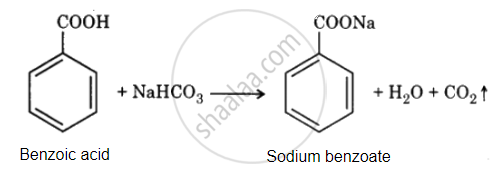
Phenol Br2 decolourises water to give white precipitate but does not give benzoic acid.

APPEARS IN
संबंधित प्रश्न
Distinguish between:
C6H5-COCH3 and C6H5-CHO
Predict the products of the following reactions :

How will you convert ethanal into the following compound?
But-2-enoic acid
Give a simple chemical test to distinguish between the following pair of compounds:
Acetophenone and Benzophenone
Give a simple chemical test to distinguish between the following pair of compounds:
Benzoic acid and Ethyl benzoate
Give a simple chemical test to distinguish between the following pair of compounds:
Benzaldehyde and Acetophenone
Alkenes decolourise bromine water in presence of CCl4 due to formation of ______.
Which of the following compounds will give butanone on oxidation with alkaline \[\ce{KMnO4}\] solution?
Solvent used for dewaxing of petroleum products are
Acetone and acetaldehyde are differentiated by
Acetaldehyde cannot show?
Fehilng's test is positive for
Which of the following tests/reactions is given by aldehydes as well as ketones?
A hydrocarbon (A) with molecular formula C5H10 on ozonolysis gives two products (B) and (C). Both (B) and (C) give a yellow precipitate when heated with iodine in presence of NaOH while only (B) give a silver mirror on reaction with Tollen’s reagent.
- Identify (A), (B) and (C).
- Write the reaction of B with Tollen’s reagent.
- Write the equation for iodoform test for C.
- Write down the equation for aldol condensation reaction of B and C.
In Tollen's test for aldehyde, the overall number of electrons(s) transferred to the Tollen's reagent formula \[\ce{[Ag(NH3)2]+}\] per aldehyde group to form silver mirror is ______. (Round off to the nearest integer)
You are given four organic compounds “A”, “B” , “C” and “D”. The compounds “A”, “B” and “C” form an orange-red precipitate with 2, 4 DNP reagent. Compounds “A” and “B” reduce Tollen’s reagent while compounds “C” and “D” do not. Both “B” and “C” give a yellow precipitate when heated with iodine in the presence of NaOH. Compound “D” gives brisk effervescence with sodium bicarbonate solution. Identify “A”, “B”, “C” and “D” given the number of carbon atoms in three of these carbon compounds is three while one has two carbon atoms. Give an explanation for our answer.
Benzaldehyde is obtained from Rosenmund’s reduction of:
Match List-I with List-II:
| List-I (Reaction) |
List-II (Reagents/Condition) |
||
| A. | 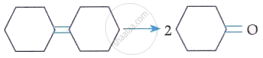 |
I. | 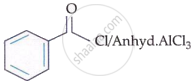 |
| B. | 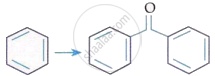 |
II. | CrO3 |
| C. | 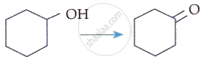 |
III. | KMnO4/KOH, Δ |
| D. | 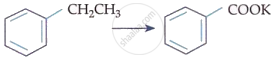 |
IV. | (i) O3 (ii) Zn-H2O |
Choose the correct answer from the options given below:
