Advertisements
Advertisements
प्रश्न
From the rate expression for the following reaction, determine the order of reaction and the dimension of the rate constant.
\[\ce{CH3CHO_{(g)} -> CH4_{(g)} + CO_{(g)}}\] Rate = k[CH3CHO]3/2
Advertisements
उत्तर
Given rate = k[CH3CHO]3/2
∴ Order of reaction = \[\ce{\frac{3}{2}}\]
Dimension of k = \[\ce{\frac{Rate}{[CH3CHO]^{3/2}}}\]
= \[\ce{\frac{(mol L^{-1} s^{-1})}{(mol L^{-1})^{3/2}}}\]
= L1/2 mol−1/2 s−1
APPEARS IN
संबंधित प्रश्न
Write molecularity of the following reaction:
2NO(g)+O2(g)→2NO2(g)
For a reaction: 
Rate = k
(i) Write the order and molecularity of this reaction.
(ii) Write the unit of k.
Write two factors that affect the rate of reaction.
For a reaction, \[\ce{A + B -> Product}\]; the rate law is given by, r = k [A]1/2 [B]2. What is the order of the reaction?
A reaction is first order in A and second order in B. Write the differential rate equation.
How does calcination differ from roasting?
Write the principle behind the following methods of refining:
Hydraulic washing
What is the order of a reaction which has a rate expression; Rate = `"k"["A"]^(3/2)["B"]^1`?
Match the graph given in Column I with the order of reaction given in Column II. More than one item in Column I may link to the same item of Column II.
| Column I | Column II | |
| (i) | 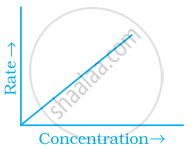 |
|
| (ii) | 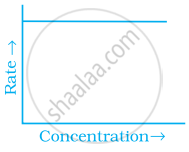 |
(a) 1st order |
| (iii) | 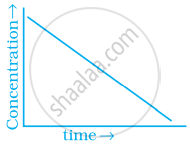 |
(b) Zero-order |
| (iv) | 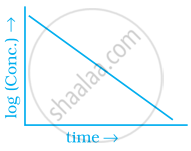 |
Assertion: The enthalpy of reaction remains constant in the presence of a catalyst.
Reason: A catalyst participating in the reaction, forms different activated complex and lowers down the activation energy but the difference in energy of reactant and product remains the same.
In the presence of a catalyst, the heat evolved or absorbed during the reaction.
The rate constant for the reaction \[\ce{2H2O5 -> 4NO2 + O2}\] is 30 × 10–5 sec–1. if the rate is 204 × 10–5 mol L–1 S–1, then the concentration of N2O5 (in mol–1) is-
For the reaction, \[\ce{A +2B → AB2}\], the order w.r.t. reactant A is 2 and w.r.t. reactant B. What will be change in rate of reaction if the concentration of A is doubled and B is halved?
On heating compound (A) gives a gas (B) which is constituent of air. The gas when treated with H2 in the presence of catalyst gives another gas (C) which is basic in nature, (A) should not be ______.
The following data was obtained for chemical reaction given below at 975 K.
\[\ce{2NO(g) + 2H2(g) -> N2(g) + 2H2O(g)}\]
| [NO] | [H2] | Rate | |
| Mol L-1 | Mol L-1 | Mol L-1 s-1 | |
| (1) | 8 × 10⁻⁵ | 8 × 10⁻⁵ | 7 × 10⁻⁹ |
| (2) | 24 × 10-5 | 8 × 10⁻⁵ | 2.1 × 10⁻⁸ |
| (3) | 24 × 10-5 | 32 × 10-5 | 8.4 × 10⁻⁸ |
The order of the reaction with respect to NO is ______. (Integer answer)
A flask contains a mixture of compounds A and B. Both compounds decompose by first-order kinetics. The half-lives for A and B are 300 s and 180 s, respectively. If the concentrations of A and B are equal initially, the time required for the concentration of A to be four times that of B (in s) is ______. (Use ln 2 = 0.693)
Assertion (A): Order of reaction is applicable to elementary as well as complex reactions.
Reason (R): For a complex reaction, molecularity has no meaning.
