Advertisements
Advertisements
प्रश्न
Find the distance between the lines:
`vecr = (hati + 2hatj - 4hatk) + λ(2hati + 3hatj + 6hatk)`;
`vecr = (3hati + 3hatj - 5hatk) + μ(4hati + 6hatj + 12hatk)`
Advertisements
उत्तर
Lines are parallel
`a_1/a_2 = b_1/b_2 = c_1/c_2`
`2/4 = 3/6 = 6/12`
`1/2 = 1/2 = 1/2`
`vecb = 2hati + 3hatj + 6hatk`
`|vecb| = sqrt(4 + 9 + 36)`
= `sqrt(49)`
= 7
S.D. = `|(vecb xx (veca_2 - veca_1))/|vecb||`
`veca_1 = hati + 2hatj - 4hatk`
`veca_2 = 3hati + 3hatj - 5hatk`
`veca_2 - veca_1 = 2hati + hatj - hatk`
`vecb xx (veca_2 - veca_1) = |(hati, hatj, hatk),(2, 3, 6),(2, 1, -1)|`
= `-9hati + 14hatj - 4hatk`
`|vecb xx (veca_2 - veca_1)| = sqrt(81 + 196 + 16)`
= `sqrt(293)`
S.D. = `sqrt(293)/7` units.
APPEARS IN
संबंधित प्रश्न
Find the shortest distance between the lines
`bar r = (4 hat i - hat j) + lambda(hat i + 2 hat j - 3 hat k)`
and
`bar r = (hat i - hat j + 2 hat k) + mu(hat i + 4 hat j -5 hat k)`
where λ and μ are parameters
Show that the following two lines are coplanar:
`(x−a+d)/(α−δ)= (y−a)/α=(z−a−d)/(α+δ) and (x−b+c)/(β−γ)=(y−b)/β=(z−b−c)/(β+γ)`
Find the distance between the planes 2x - y + 2z = 5 and 5x - 2.5y + 5z = 20
Find the shortest distance between the lines:
`vecr = (hati+2hatj+hatk) + lambda(hati-hatj+hatk)` and `vecr = 2hati - hatj - hatk + mu(2hati + hatj + 2hatk)`
Find the shortest distance between the lines.
`(x + 1)/7 = (y + 1)/(- 6) = (z + 1)/1` and `(x - 3)/1 = (y - 5)/(- 2) = (z - 7)/1`.
Find the shortest distance between the lines whose vector equations are `vecr = (1-t)hati + (t - 2)hatj + (3 -2t)hatk` and `vecr = (s+1)hati + (2s + 1)hatk`.
Find the shortest distance between the lines `(x+1)/7=(y+1)/(-6)=(z+1)/1 and (x-3)/1=(y-5)/(-2)=(z-7)/1`
Find the shortest distance between the lines `vec r = hat i + 2hat j + 3 hat k + lambda(2 hat i + 3hatj + 4hatk)` and `vec r = 2hat i + 4 hat j + 5 hat k + mu (4hat i + 6 hat j + 8 hat k)`
Find the shortest distance between the lines
Find the shortest distance between the lines given by `vec"r" = (8 + 3lambdahat"i" - (9 + 16lambda)hat"j" + (10 + 7lambda)hat"k"` and `vec"r" = 15hat"i" + 29hat"j" + 5hat"k" + mu(3hat"i" + 8hat"j" - 5hat"k")`
|
The fuel cost per hour for running a train is proportional to the square of the speed it generates in km per hour. If the fuel costs ₹ 48 per hour at a speed of 16 km per hour and the fixed charges to run the train amount to ₹ 1200 per hour. Assume the speed of the train as v km/h. |
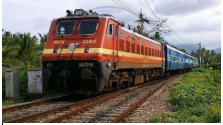
If the train has travelled a distance of 500 km, then the total cost of running the train is given by the function:
Find the shortest distance between the following lines:
`vecr = (hati + hatj - hatk) + s(2hati + hatj + hatk)`
`vecr = (hati + hatj - 2hatk) + t(4hati + 2hatj + 2hatk)`
Find the equation of line which passes through the point (1, 2, 3) and is parallel to the vector `3hati + 2hatj - 2hatk`
The planes `2x - y + 4z` = 5 and `5x - 2.5y + 10z` = 6
Read the following passage and answer the questions given below.
|
Two motorcycles A and B are running at the speed more than the allowed speed on the roads represented by the lines `vecr = λ(hati + 2hatj - hatk)` and `vecr = (3hati + 3hatj) + μ(2hati + hatj + hatk)` respectively.
|
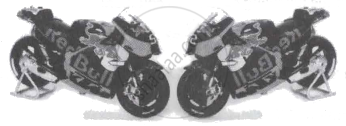
Based on the above information, answer the following questions:
- Find the shortest distance between the given lines.
- Find the point at which the motorcycles may collide.
Find the shortest distance between the following lines:
`vecr = 3hati + 5hatj + 7hatk + λ(hati - 2hatj + hatk)` and `vecr = (-hati - hatj - hatk) + μ(7hati - 6hatj + hatk)`.
The largest value of a, for which the perpendicular distance of the plane containing the lines `vec"r" = (hat"i" + hat"j") + λ(hat"i" + "a"hat"j" - hat"k")` and `vec"r" = (hat"i" + hat"j") + μ(-hat"i" + hat"j" - "a"hat"k")` from the point (2, 1, 4) is `sqrt(3)`, is ______.
If the shortest distance between the lines `(x - 1)/2 = (y - 2)/3 = (z - 3)/λ` and `(x - 2)/1 = (y - 4)/4 = (z - 5)/5` is `1/sqrt(3)`, then the sum of all possible values of λ is ______.
The shortest distance between the z-axis and the line x + y + 2z – 3 = 0 = 2x + 3y + 4z – 4, is ______.
For parallel lines with common direction vector \[\vec{b}\], which expression gives \[SD\]?
Which vector form gives the distance \[\mathbf d\] between skew lines?
For the Cartesian form of the distance between skew lines, which determinant is the numerator?
What is the distance between \[\vec r=(\hat i+\hat j)+\lambda(2\hat i-\hat j+\hat k)\] and \[\vec r=(2\hat i+\hat j-\hat k)+\mu(3\hat i-5\hat j+2\hat k)\]?
What is \[SD\] for intersecting lines?
For skew lines, which expression gives \[SD\]?
