Advertisements
Advertisements
प्रश्न
Find the distance between the planes 2x - y + 2z = 5 and 5x - 2.5y + 5z = 20
Advertisements
उत्तर १
`2/5 = - 1/(-2.5) = 2/5`
`2/5 = 2/5 = 2/5`
⇒ parallel planes
`5x - 5/2 y + 5z= 20 xx 2/5`
`=> 2x - y + 2z = 8` and `2x - y + 2z = 5`
`=> d = |(8-5)/sqrt(4+1+4)| = 3/sqrt9 = "1 unit"`
उत्तर २
Consider the equations of planes, 2x – y + 2z = 5 and 5x – 2.5y + 5z = 20.
Here, we can see the above two planes are parallel planes.
As, 5x – 2.5y + 5z = 20 can also be written as 2x – y + 2z = 8
If the equation of two parallel planes are
ax + by + cz + d1 = 0 and ax + by + cz + d2 = 0
Then, distance between the two parallel planes is given by:
`d = |(d_2 - d_1)/sqrt(a^2 +b^2 +c^2)|`
let us take the two parallel planes be 2x – y + 2z = 5 and 2x – y + 2z = 8
Therefore the distance is given by:
`d = |(5-8)/(sqrt(2^2 + (-1)^2 +2^2))|`
= `|(-3)/(sqrt(2^2 + (-1)^2) + 2^2)|`
= `|(-3)/sqrt(4+1+4)|`
= `|(-3)/3|`
= 1
Hence the distance between the given two planes is 1 units.
संबंधित प्रश्न
Show that the following two lines are coplanar:
`(x−a+d)/(α−δ)= (y−a)/α=(z−a−d)/(α+δ) and (x−b+c)/(β−γ)=(y−b)/β=(z−b−c)/(β+γ)`
Show that lines:
`vecr=hati+hatj+hatk+lambda(hati-hat+hatk)`
`vecr=4hatj+2hatk+mu(2hati-hatj+3hatk)` are coplanar
Also, find the equation of the plane containing these lines.
Find the shortest distance between the lines whose vector equations are `vecr = (1-t)hati + (t - 2)hatj + (3 -2t)hatk` and `vecr = (s+1)hati + (2s + 1)hatk`.
Find the shortest distance between lines `vecr = 6hati + 2hatj + 2hatk + lambda(hati - 2hatj + 2hatk)` and `vecr =-4hati - hatk + mu(3hati - 2hatj - 2hatk)`.
Find the shortest distance between the lines `(x+1)/7=(y+1)/(-6)=(z+1)/1 and (x-3)/1=(y-5)/(-2)=(z-7)/1`
Find the shortest distance between the lines
Find the shortest distance between the lines
Find the shortest distance between the lines given by `vec"r" = (8 + 3lambdahat"i" - (9 + 16lambda)hat"j" + (10 + 7lambda)hat"k"` and `vec"r" = 15hat"i" + 29hat"j" + 5hat"k" + mu(3hat"i" + 8hat"j" - 5hat"k")`
|
The fuel cost per hour for running a train is proportional to the square of the speed it generates in km per hour. If the fuel costs ₹ 48 per hour at a speed of 16 km per hour and the fixed charges to run the train amount to ₹ 1200 per hour. Assume the speed of the train as v km/h. |
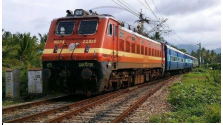
The fuel cost for the train to travel 500 km at the most economical speed is:
Find the shortest distance between the following lines:
`vecr = (hati + hatj - hatk) + s(2hati + hatj + hatk)`
`vecr = (hati + hatj - 2hatk) + t(4hati + 2hatj + 2hatk)`
Find the equation of line which passes through the point (1, 2, 3) and is parallel to the vector `3hati + 2hatj - 2hatk`
Find the angle between the following pair of lines:- `(x - 2)/ = (y - 1)/5 = (z + 3)/(-3)` and `(x + 2)/(-1) = (y - 4)/8 = (z - 5)/4`
Distance between the planes :-
`2x + 3y + 4z = 4` and `4x + 6y + 8z = 12` is
If the shortest distance between the lines `vecr_1 = αhati + 2hatj + 2hatk + λ(hati - 2hatj + 2hatk)`, λ∈R, α > 0 `vecr_2 = - 4hati - hatk + μ(3hati - 2hatj - 2hatk)`, μ∈R is 9, then α is equal to ______.
The shortest distance between the line y = x and the curve y2 = x – 2 is ______.
The shortest distance between the z-axis and the line x + y + 2z – 3 = 0 = 2x + 3y + 4z – 4, is ______.
The lines `vecr = hati + hatj - hatk + λ(2hati + 3hatj - 6hatk)` and `vecr = 2hati - hatj - hatk + μ(6hati + 9hatj - 18hatk)`; (where λ and μ are scalars) are ______.
What does the concept of shortest distance help in finding when two lines do not meet directly?
For parallel lines with common direction vector \[\vec{b}\], which expression gives \[SD\]?
Given \[\vec r=\vec a_1+\lambda\vec b_1\] and \[\vec r=\vec a_2+\mu\vec b_2\], what are \[\vec b_1\] and \[\vec b_2\]?
Which vector form gives the distance \[\mathbf d\] between skew lines?
For the Cartesian form of the distance between skew lines, which determinant is the numerator?
For \[\vec a_1=\hat i+\hat j\] and \[\vec a_2=2\hat i+\hat j-\hat k\], what is \[\vec a_2-\vec a_1\]?
What is the distance between \[\vec r=(\hat i+\hat j)+\lambda(2\hat i-\hat j+\hat k)\] and \[\vec r=(2\hat i+\hat j-\hat k)+\mu(3\hat i-5\hat j+2\hat k)\]?
For the parallel lines with \[\vec a_2-\vec a_1=2\hat i+\hat j-\hat k\] and \[\vec b=2\hat i+3\hat j+6\hat k\], what is \[\vec b\times(\vec a_2-\vec a_1)\]?
What is the distance between \[\vec r=(\hat i+2\hat j-4\hat k)+\lambda(2\hat i+3\hat j+6\hat k)\] and \[\vec r=(3\hat i+3\hat j-5\hat k)+\mu(2\hat i+3\hat j+6\hat k)\]?
What is \[SD\] for intersecting lines?
