Advertisements
Advertisements
प्रश्न
Find the differential equation of the family of circles passing through the origin and having their centres on the x-axis
Advertisements
उत्तर
Given the circles centre on x-axis and the circle is passing through the origin.
Let it be (r, 0) and its radius r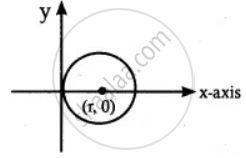
Equation of the circle is
(x – a)2 + (y – b)2 = r2
(x – r)2 + (y – 0)2 = r2
x2 – 2xr + r2 + y2 = r2
x2 – 2xr + y2 = r2 – r2
x2 – 2xr + y2 = 0 ........(1)
Differentiating equation (1) with respect to ‘x’, we get
2x – 2r + 2y `("d"y)/("d"x)` = 0 dx
2x + 2y `("d"y)/("d"x)` = 2r
`x + y ("d"y)/("d"x)` = r
Substituting r value in equation (1), we get
`x^2 - 2x(x + y ("d"y)/("d"x)) + y^2` = 0
`x^2 - 2x^2 - 2xy ("d"y)/("d"x) + y^2` = 0
`- x^2 - 2xy ("d"y)/("d"x) + y^2` = 0
Multiply by '_', we et
`x^2+ 2xy ("d"y)/("d"x) - y^2` = 0
Which is a required differential equation.
APPEARS IN
संबंधित प्रश्न
Find the differential equation of the ellipse whose major axis is twice its minor axis.
In the following example verify that the given expression is a solution of the corresponding differential equation:
y = e-x + Ax + B; `"e"^"x" ("d"^2"y")/"dx"^2 = 1`
Solve the following differential equation:
`"sec"^2 "x" * "tan y" "dx" + "sec"^2 "y" * "tan x" "dy" = 0`
For the following differential equation find the particular solution satisfying the given condition:
`("x" + 1) "dy"/"dx" - 1 = 2"e"^-"y" , "y" = 0`, when x = 1
Reduce the following differential equation to the variable separable form and hence solve:
`cos^2 ("x - 2y") = 1 - 2 "dy"/"dx"`
Solve the following differential equation:
(x2 + y2)dx - 2xy dy = 0
The particular solution of `dy/dx = xe^(y - x)`, when x = y = 0 is ______.
Choose the correct option from the given alternatives:
`"x"^2/"a"^2 - "y"^2/"b"^2 = 1` is a solution of
In the following example verify that the given function is a solution of the differential equation.
`"y" = "e"^"ax" sin "bx"; ("d"^2"y")/"dx"^2 - 2"a" "dy"/"dx" + ("a"^2 + "b"^2)"y" = 0`
In the following example verify that the given function is a solution of the differential equation.
`"xy" = "ae"^"x" + "be"^-"x" + "x"^2; "x" ("d"^2"y")/"dx"^2 + 2 "dy"/"dx" + "x"^2 = "xy" + 2`
Obtain the differential equation by eliminating the arbitrary constants from the following equation:
y = a sin (x + b)
Solve the following differential equation:
x dy = (x + y + 1) dx
The general solution of `(dy)/(dx)` = e−x is ______.
Find the general solution of `("d"y)/("d"x) = (1 + y^2)/(1 + x^2)`
Form the differential equation of all straight lines touching the circle x2 + y2 = r2
Find the differential equation of the family of all the parabolas with latus rectum 4a and whose axes are parallel to the x-axis
The differential equation of all lines perpendicular to the line 5x + 2y + 7 = 0 is ____________.
The differential equation for all the straight lines which are at the distance of 2 units from the origin is ______.
For the curve C: (x2 + y2 – 3) + (x2 – y2 – 1)5 = 0, the value of 3y' – y3 y", at the point (α, α), α < 0, on C, is equal to ______.
Form the differential equation whose general solution is y = a cos 2x + b sin 2x.
