Advertisements
Advertisements
प्रश्न
Find the differential equation of the family of circles passing through the origin and having their centres on the x-axis
Advertisements
उत्तर
Given the circles centre on x-axis and the circle is passing through the origin.
Let it be (r, 0) and its radius r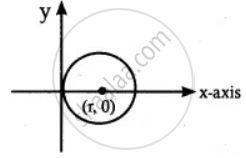
Equation of the circle is
(x – a)2 + (y – b)2 = r2
(x – r)2 + (y – 0)2 = r2
x2 – 2xr + r2 + y2 = r2
x2 – 2xr + y2 = r2 – r2
x2 – 2xr + y2 = 0 ........(1)
Differentiating equation (1) with respect to ‘x’, we get
2x – 2r + 2y `("d"y)/("d"x)` = 0 dx
2x + 2y `("d"y)/("d"x)` = 2r
`x + y ("d"y)/("d"x)` = r
Substituting r value in equation (1), we get
`x^2 - 2x(x + y ("d"y)/("d"x)) + y^2` = 0
`x^2 - 2x^2 - 2xy ("d"y)/("d"x) + y^2` = 0
`- x^2 - 2xy ("d"y)/("d"x) + y^2` = 0
Multiply by '_', we et
`x^2+ 2xy ("d"y)/("d"x) - y^2` = 0
Which is a required differential equation.
APPEARS IN
संबंधित प्रश्न
Obtain the differential equation by eliminating the arbitrary constants from the following equation:
Ax2 + By2 = 1
Obtain the differential equation by eliminating the arbitrary constants from the following equation:
y = e−2x (A cos x + B sin x)
In the following example verify that the given expression is a solution of the corresponding differential equation:
y = `"e"^"ax"; "x" "dy"/"dx" = "y" log "y"`
Solve the following differential equation:
`"sec"^2 "x" * "tan y" "dx" + "sec"^2 "y" * "tan x" "dy" = 0`
Solve the following differential equation:
`"dy"/"dx" = - "k",` where k is a constant.
For the following differential equation find the particular solution satisfying the given condition:
3ex tan y dx + (1 + ex) sec2 y dy = 0, when x = 0, y = π.
Reduce the following differential equation to the variable separable form and hence solve:
`"dy"/"dx" = cos("x + y")`
Solve the following differential equation:
(x2 + y2)dx - 2xy dy = 0
The integrating factor of linear differential equation `x dy/dx + 2y = x^2 log x` is ______.
Obtain the differential equation by eliminating the arbitrary constants from the following equation:
y = `sqrt("a" cos (log "x") + "b" sin (log "x"))`
Solve the following differential equation:
`"dy"/"dx" + "y cot x" = "x"^2 "cot x" + "2x"`
Find the particular solution of the following differential equation:
`"dy"/"dx" - 3"y" cot "x" = sin "2x"`, when `"y"(pi/2) = 2`
Find the particular solution of the following differential equation:
(x + y)dy + (x - y)dx = 0; when x = 1 = y
The family of curves y = `e^("a" sin x)`, where a is an arbitrary constant, is represented by the differential equation.
Find the differential equation of the family of all non-vertical lines in a plane
The differential equation of all lines perpendicular to the line 5x + 2y + 7 = 0 is ____________.
Solve the following differential equation:
`xsin(y/x)dy = [ysin(y/x) - x]dx`
Find the particular solution of the differential equation `x^2 dy/dx + y^2 = xy dy/dx`, if y = 1 when x = 1.
Solve the differential equation
ex tan y dx + (1 + ex) sec2 y dy = 0
