Advertisements
Advertisements
प्रश्न
Find the area of greatest rectangle that can be inscribed in an ellipse `x^2/"a"^2 + y^2/"b"^2` = 1
Advertisements
उत्तर
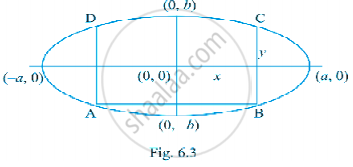
Let ABCD be the rectangle of maximum area with sides AB = 2x and BC = 2y
Where C (x, y) is a point on the ellipse `x^2/"a"^2 + y^2/"b"^2` = 1 as shown in the Fig.6.3.
The area A of the rectangle is 4xy
i.e. A = 4xy which gives A2 = 16x2y2 = s ....(say)
Therefore, s = `16x^2 (1 - x^2/"a"^2)*"b"^2`
= `(16"b"^2)/"a"^2 ("a"^2x^2 - x^4)`
⇒ `"ds"/"dx" = (16"b"^2)/"a"^2 * [2"a"^2x - 4x^3]`
Again, `"ds"/"dx"` = 0
⇒ x = `"a"/sqrt(2)` nad y = `"b"/sqrt(2)`
Now, `("d"^2"s")/("dx"^2) = (16"b"^2)/"a"^2 [2"a"^2 - 12x^2]`
At x = `"a"/sqrt(2), ("d"^2"s")/("dx"^2)`
= `(16"b"^2)/"a"^2 [2"a"^2 - 6"a"^2]`
= `(16"b"^2)/"a"62 (-4"a"^2) < 0`
Thus at x = `"a"/sqrt(2)`, y = `"b"/sqrt(2)`
s is maximum and hence the area A is maximum.
Maximum area = 4.x.y
= `4 * "a"/sqrt(2) * "b"/sqrt(2)`
= 2ab sq units.
APPEARS IN
संबंधित प्रश्न
Find the local maxima and local minima, of the function f(x) = sin x − cos x, 0 < x < 2π.
A cone is inscribed in a sphere of radius 12 cm. If the volume of the cone is maximum, find its height
Verify Rolle's theorem for the following function on the indicated interval f(x) = x2 − 8x + 12 on [2, 6] ?
Verify Rolle's theorem for the following function on the indicated interval f (x) = (x2 − 1) (x − 2) on [−1, 2] ?
Verify Rolle's theorem for the following function on the indicated interval f (x) = x(x − 4)2 on the interval [0, 4] ?
Verify Rolle's theorem for the following function on the indicated interval f (x) = x2 + 5x + 6 on the interval [−3, −2] ?
Verify Rolle's theorem for the following function on the indicated interval f(x) = sin 2x on [0, π/2] ?
Verify Rolle's theorem for the following function on the indicated interval f(x) = ex sin x on [0, π] ?
Verify Rolle's theorem for the following function on the indicated interval f (x) = log (x2 + 2) − log 3 on [−1, 1] ?
Examine if Rolle's theorem is applicable to any one of the following functions.
(i) f (x) = [x] for x ∈ [5, 9]
(ii) f (x) = [x] for x ∈ [−2, 2]
Can you say something about the converse of Rolle's Theorem from these functions?
Verify Lagrange's mean value theorem for the following function on the indicated intervals. find a point 'c' in the indicated interval as stated by the Lagrange's mean value theore \[f\left( x \right) = \sqrt{25 - x^2}\] on [−3, 4] ?
Verify Lagrange's mean value theorem for the following function on the indicated intervals. find a point 'c' in the indicated interval as stated by the Lagrange's mean value theorem \[f\left( x \right) = x + \frac{1}{x} \text { on }[1, 3]\] ?
Verify Lagrange's mean value theorem for the following function on the indicated intervals. find a point 'c' in the indicated interval as stated by the Lagrange's mean value theorem f(x) = x(x + 4)2 on [0, 4] ?
Verify Lagrange's mean value theorem for the following function on the indicated intervals. find a point 'c' in the indicated interval as stated by the Lagrange's mean value theorem f(x) = x2 + x − 1 on [0, 4] ?
Verify Lagrange's mean value theorem for the following function on the indicated intervals. find a point 'c' in the indicated interval as stated by the Lagrange's mean value theorem f(x) = x3 − 5x2 − 3x on [1, 3] ?
Verify the hypothesis and conclusion of Lagrange's man value theorem for the function
f(x) = \[\frac{1}{4x - 1},\] 1≤ x ≤ 4 ?
Find the points on the curve y = x3 − 3x, where the tangent to the curve is parallel to the chord joining (1, −2) and (2, 2) ?
State Lagrange's mean value theorem ?
If the value of c prescribed in Rolle's theorem for the function f (x) = 2x (x − 3)n on the interval \[[0, 2\sqrt{3}] \text { is } \frac{3}{4},\] write the value of n (a positive integer) ?
Find the value of c prescribed by Lagrange's mean value theorem for the function \[f\left( x \right) = \sqrt{x^2 - 4}\] defined on [2, 3] ?
For the function f (x) = x + \[\frac{1}{x}\] ∈ [1, 3], the value of c for the Lagrange's mean value theorem is
The value of c in Rolle's theorem for the function \[f\left( x \right) = \frac{x\left( x + 1 \right)}{e^x}\] defined on [−1, 0] is
The value of c in Lagrange's mean value theorem for the function f (x) = x (x − 2) when x ∈ [1, 2] is
Find the points on the curve x2 + y2 − 2x − 3 = 0 at which the tangents are parallel to the x-axis ?
If f(x) = `1/(4x^2 + 2x + 1)`, then its maximum value is ______.
Minimum value of f if f(x) = sinx in `[(-pi)/2, pi/2]` is ______.
At what point, the slope of the curve y = – x3 + 3x2 + 9x – 27 is maximum? Also find the maximum slope.
If the graph of a differentiable function y = f (x) meets the lines y = – 1 and y = 1, then the graph ____________.
The least value of the function f(x) = 2 cos x + x in the closed interval `[0, π/2]` is:
The minimum value of `1/x log x` in the interval `[2, oo]` is
The function f(x) = [x], where [x] =greater integer of x, is
Let y = `f(x)` be the equation of a curve. Then the equation of tangent at (xo, yo) is :-
Which statement about local extrema and absolute extrema is correct?
How are the absolute maximum and absolute minimum determined after evaluating \[f(x)\] at all critical points and endpoints?
For \[f(x)=12x^{\frac{4}{3}}-6x^{\frac{1}{3}}\], which derivative is correct?
What is \[f\left(\frac{1}{8}\right)\] for \[f(x)=12x^{\frac{4}{3}}-6x^{\frac{1}{3}}\]?
What are the absolute extrema of \[f(x)=12x^{\frac{4}{3}}-6x^{\frac{1}{3}}\] on \[-1,1\]?
