Advertisements
Advertisements
प्रश्न
Show that height of the cylinder of greatest volume which can be inscribed in a right circular cone of height h and semi-vertical angle α is one-third that of the cone and the greatest volume of the cylinder is `(4)/(27) pi"h"^3 tan^2 α`.
Advertisements
उत्तर
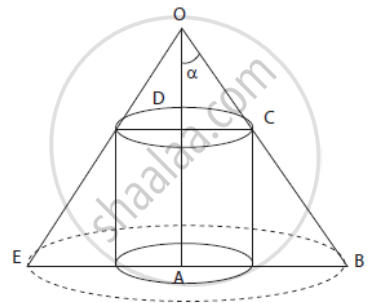
Let CD = R, AD = x
⇒ OD = h - x
∵ ODC ∼ ΔOAB
⇒ `(h - x)/h = R/"AB" ⇒ (h - x)/h = R/(h tan α)`
⇒ R = (h - x) tan α
V = πR2x
= π(h - x)2 tan2α. x
= π tan2α (h - x)2x
`dV/dx = π tan2α (h2 - 4hx + 3x2)`
`dV/dx = 0 = h^2 - 4hx + 3x^2 = 0`
⇒ (h - x)(h - 3x) = 0
⇒ x = h (not possible ) or x =` h/3`
`(d^2V)/(dx^2) = π tan^2α (-4h + 6x)`
`((d^2V)/(dx^2))_(x = h/3) = π tan^2α (-2h) < 0`
⇒ V is maximum for x = `h/3`.
So, Vmax = π tan2α (h - x)2x
`= π tan^2α ( h - h/3 )^2 h/3`
= `(4πh)^3/27 tan^2 a`
APPEARS IN
संबंधित प्रश्न
f (x) = x2/3 on [−1, 1] Discuss the applicability of Rolle's theorem for the following function on the indicated intervals ?
Verify Rolle's theorem for the following function on the indicated interval f (x) = x(x − 4)2 on the interval [0, 4] ?
Verify Rolle's theorem for the following function on the indicated interval f(x) = ex sin x on [0, π] ?
Verify Rolle's theorem for the following function on the indicated interval f(x) = 2 sin x + sin 2x on [0, π] ?
Verify Rolle's theorem for the following function on the indicated interval f(x) = sin4 x + cos4 x on \[\left[ 0, \frac{\pi}{2} \right]\] ?
Verify Lagrange's mean value theorem for the following function on the indicated intervals. find a point 'c' in the indicated interval as stated by the Lagrange's mean value theorem f(x) = x3 − 2x2 − x + 3 on [0, 1] ?
Verify Lagrange's mean value theorem for the following function on the indicated intervals. find a point 'c' in the indicated interval as stated by the Lagrange's mean value theorem f(x) = x2 − 3x + 2 on [−1, 2] ?
Verify Lagrange's mean value theorem for the following function on the indicated intervals. find a point 'c' in the indicated interval as stated by the Lagrange's mean value theore f(x) = tan−1 x on [0, 1] ?
Verify Lagrange's mean value theorem for the following function on the indicated intervals. find a point 'c' in the indicated interval as stated by the Lagrange's mean value theorem f(x) = x(x + 4)2 on [0, 4] ?
Verify Lagrange's mean value theorem for the following function on the indicated intervals. find a point 'c' in the indicated interval as stated by the Lagrange's mean value theorem f(x) = x2 + x − 1 on [0, 4] ?
Verify Lagrange's mean value theorem for the following function on the indicated intervals. find a point 'c' in the indicated interval as stated by the Lagrange's mean value theorem f(x) = sin x − sin 2x − x on [0, π] ?
Let C be a curve defined parametrically as \[x = a \cos^3 \theta, y = a \sin^3 \theta, 0 \leq \theta \leq \frac{\pi}{2}\] . Determine a point P on C, where the tangent to C is parallel to the chord joining the points (a, 0) and (0, a).
Using Lagrange's mean value theorem, prove that (b − a) sec2 a < tan b − tan a < (b − a) sec2 b
where 0 < a < b < \[\frac{\pi}{2}\] ?
If 4a + 2b + c = 0, then the equation 3ax2 + 2bx + c = 0 has at least one real root lying in the interval
For the function f (x) = x + \[\frac{1}{x}\] ∈ [1, 3], the value of c for the Lagrange's mean value theorem is
The value of c in Rolle's theorem when
f (x) = 2x3 − 5x2 − 4x + 3, x ∈ [1/3, 3] is
When the tangent to the curve y = x log x is parallel to the chord joining the points (1, 0) and (e, e), the value of x is ______.
An isosceles triangle of vertical angle 2θ is inscribed in a circle of radius a. Show that the area of triangle is maximum when θ = `pi/6`
The maximum value of sinx + cosx is ______.
At what point, the slope of the curve y = – x3 + 3x2 + 9x – 27 is maximum? Also find the maximum slope.
The least value of the function f(x) = 2 cos x + x in the closed interval `[0, π/2]` is:
It is given that at x = 1, the function x4 - 62x2 + ax + 9 attains its maximum value on the interval [0, 2]. Find the value of a.
If f(x) = ax2 + 6x + 5 attains its maximum value at x = 1, then the value of a is
The minimum value of `1/x log x` in the interval `[2, oo]` is
For a continuous function on the closed interval \[a,d\], what does \[f(a)\] represent?
For a continuous function on the closed interval \[a,d\], what does \[f(b)\] represent?
What is \[f(-1)\] for \[f(x)=12x^{\frac{4}{3}}-6x^{\frac{1}{3}}\]?
