Advertisements
Advertisements
प्रश्न
Find the image of the point (3, 8) with respect to the line x + 3y = 7 assuming the line to be a plane mirror.
Advertisements
उत्तर
Let the image of A (3,8) be B (a,b). Also, let M be the midpoint of AB.
\[\therefore\text { Coordinates of M } = \left( \frac{3 + a}{2}, \frac{8 + b}{2} \right)\]
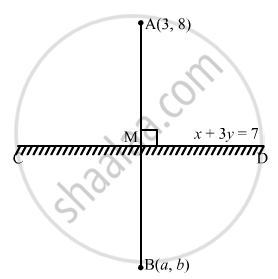
Point M lies on the line x + 3y = 7
\[\therefore \frac{3 + a}{2} + 3 \times \left( \frac{8 + b}{2} \right) = 7\]
\[\Rightarrow a + 3b + 13 = 0\] ... (1)
Lines CD and AB are perpendicular.
∴ Slope of AB \[\times\] Slope of CD = −1
\[\Rightarrow \frac{b - 8}{a - 3} \times \left( - \frac{1}{3} \right) = - 1\]
\[ \Rightarrow b - 8 = 3a - 9\]
\[\Rightarrow 3a - b - 1 = 0\] ... (2)
Solving (1) and (2) by cross multiplication, we get:
\[\frac{a}{- 3 + 13} = \frac{b}{39 + 1} = \frac{1}{- 1 - 9}\]
\[ \Rightarrow a = - 1, b = - 4\]
Hence, the image of the point (3, 8) with respect to the line mirror x + 3y = 7 is (−1, −4).
APPEARS IN
संबंधित प्रश्न
Without using the Pythagoras theorem, show that the points (4, 4), (3, 5) and (–1, –1) are the vertices of a right angled triangle.
Find the angle between the x-axis and the line joining the points (3, –1) and (4, –2).
Find the value of p so that the three lines 3x + y – 2 = 0, px + 2y – 3 = 0 and 2x – y – 3 = 0 may intersect at one point.
Find the slope of a line passing through the following point:
(3, −5), and (1, 2)
Find the slope of a line (i) which bisects the first quadrant angle (ii) which makes an angle of 30° with the positive direction of y-axis measured anticlockwise.
What can be said regarding a line if its slope is zero ?
The slope of a line is double of the slope of another line. If tangents of the angle between them is \[\frac{1}{3}\],find the slopes of the other line.
Find the angle between X-axis and the line joining the points (3, −1) and (4, −2).
By using the concept of slope, show that the points (−2, −1), (4, 0), (3, 3) and (−3, 2) are the vertices of a parallelogram.
Find the equation of a straight line with slope 2 and y-intercept 3 .
Find the equations of the bisectors of the angles between the coordinate axes.
Find the equation of a line which is perpendicular to the line joining (4, 2) and (3, 5) and cuts off an intercept of length 3 on y-axis.
Find the equation of the strainght line intersecting y-axis at a distance of 2 units above the origin and making an angle of 30° with the positive direction of the x-axis.
Find the equation of the right bisector of the line segment joining the points (3, 4) and (−1, 2).
The line through (h, 3) and (4, 1) intersects the line 7x − 9y − 19 = 0 at right angle. Find the value of h.
If θ is the angle which the straight line joining the points (x1, y1) and (x2, y2) subtends at the origin, prove that \[\tan \theta = \frac{x_2 y_1 - x_1 y_2}{x_1 x_2 + y_1 y_2}\text { and } \cos \theta = \frac{x_1 x_2 + y_1 y_2}{\sqrt{{x_1}^2 + {y_1}^2}\sqrt{{x_2}^2 + {y_2}^2}}\].
Prove that the straight lines (a + b) x + (a − b ) y = 2ab, (a − b) x + (a + b) y = 2ab and x + y = 0 form an isosceles triangle whose vertical angle is 2 tan−1 \[\left( \frac{a}{b} \right)\].
Write the coordinates of the image of the point (3, 8) in the line x + 3y − 7 = 0.
Find k, if the slope of one of the lines given by kx2 + 8xy + y2 = 0 exceeds the slope of the other by 6.
If m1 and m2 are slopes of lines represented by 6x2 - 5xy + y2 = 0, then (m1)3 + (m2)3 = ?
If the slopes of the lines given by the equation ax2 + 2hxy + by2 = 0 are in the ratio 5 : 3, then the ratio h2 : ab = ______.
The equation of a line passing through the point (7, - 4) and perpendicular to the line passing through the points (2, 3) and (1 , - 2 ) is ______.
If x + y = k is normal to y2 = 12x, then k is ______.
Point of the curve y2 = 3(x – 2) at which the normal is parallel to the line 2y + 4x + 5 = 0 is ______.
The two lines ax + by = c and a′x + b′y = c′ are perpendicular if ______.
The coordinates of the foot of the perpendicular from the point (2, 3) on the line x + y – 11 = 0 are ______.
The reflection of the point (4, – 13) about the line 5x + y + 6 = 0 is ______.
P1, P2 are points on either of the two lines `- sqrt(3) |x|` = 2 at a distance of 5 units from their point of intersection. Find the coordinates of the foot of perpendiculars drawn from P1, P2 on the bisector of the angle between the given lines.
If p is the length of perpendicular from the origin on the line `x/a + y/b` = 1 and a2, p2, b2 are in A.P, then show that a4 + b4 = 0.
The coordinates of the foot of perpendiculars from the point (2, 3) on the line y = 3x + 4 is given by ______.
The points (3, 4) and (2, – 6) are situated on the ______ of the line 3x – 4y – 8 = 0.
The points A(– 2, 1), B(0, 5), C(– 1, 2) are collinear.
The vertex of an equilateral triangle is (2, 3) and the equation of the opposite side is x + y = 2. Then the other two sides are y – 3 = `(2 +- sqrt(3)) (x - 2)`.
The line `x/a + y/b` = 1 moves in such a way that `1/a^2 + 1/b^2 = 1/c^2`, where c is a constant. The locus of the foot of the perpendicular from the origin on the given line is x2 + y2 = c2.
The line which passes through the origin and intersect the two lines `(x - 1)/2 = (y + 3)/4 = (z - 5)/3, (x - 4)/2 = (y + 3)/3 = (z - 14)/4`, is ______.
If the line joining two points A (2, 0) and B (3, 1) is rotated about A in anticlockwise direction through an angle of 15°, then the equation of the line in new position is ______.
The lines whose vector equations are `r = 2hati - 3hatj + 7hatk + lambda (2hati + phatj + 5hatk) and r = hati - 2hatj + 3hatk + µ(3hati + phatj + phatk)` are perpendicular for all values of λ and µ if p =
