Advertisements
Advertisements
प्रश्न
Find the equation of a straight line on which length of perpendicular from the origin is four units and the line makes an angle of 120° with the positive direction of x-axis.
Advertisements
उत्तर
Given that: OM = 4 units
∠BAX = 120°
∴ ∠BAO = 180° – 120° or ∠MAO = 60°
∠MOA + MAO = 90° ......[∵ OM ⊥ AB]
θ + 60° = 90°
∴ θ = 30°
So, equation of AB in its normal form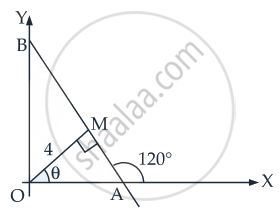
x cos θ + y sin θ = p
⇒ x cos 30° + y sin 30° = 4
⇒ `x xx sqrt(3)/4 + y xx 1/2` = 4
⇒ `sqrt(3)x + y` = 8
Hence, the required equation is `sqrt(3)x + y` = 8
APPEARS IN
संबंधित प्रश्न
Find the distance between P (x1, y1) and Q (x2, y2) when :
- PQ is parallel to the y-axis,
- PQ is parallel to the x-axis
Find a point on the x-axis, which is equidistant from the points (7, 6) and (3, 4).
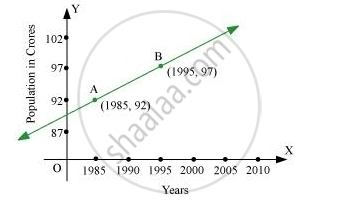
Consider the given population and year graph. Find the slope of the line AB and using it, find what will be the population in the year 2010?
Find the value of p so that the three lines 3x + y – 2 = 0, px + 2y – 3 = 0 and 2x – y – 3 = 0 may intersect at one point.
Find the slope of the lines which make the following angle with the positive direction of x-axis:
\[\frac{3\pi}{4}\]
Find the slope of a line passing through the following point:
\[(a t_1^2 , 2 a t_1 ) \text { and } (a t_2^2 , 2 a t_2 )\]
State whether the two lines in each of the following are parallel, perpendicular or neither.
Through (9, 5) and (−1, 1); through (3, −5) and (8, −3)
State whether the two lines in each of the following is parallel, perpendicular or neither.
Through (3, 15) and (16, 6); through (−5, 3) and (8, 2).
What can be said regarding a line if its slope is negative?
Without using Pythagoras theorem, show that the points A (0, 4), B (1, 2) and C (3, 3) are the vertices of a right angled triangle.
The slope of a line is double of the slope of another line. If tangents of the angle between them is \[\frac{1}{3}\],find the slopes of the other line.
Find the angle between the X-axis and the line joining the points (3, −1) and (4, −2).
Find the angle between X-axis and the line joining the points (3, −1) and (4, −2).
Find the equation of the perpendicular to the line segment joining (4, 3) and (−1, 1) if it cuts off an intercept −3 from y-axis.
Find the equation of the strainght line intersecting y-axis at a distance of 2 units above the origin and making an angle of 30° with the positive direction of the x-axis.
Find the acute angle between the lines 2x − y + 3 = 0 and x + y + 2 = 0.
Prove that the straight lines (a + b) x + (a − b ) y = 2ab, (a − b) x + (a + b) y = 2ab and x + y = 0 form an isosceles triangle whose vertical angle is 2 tan−1 \[\left( \frac{a}{b} \right)\].
Show that the tangent of an angle between the lines \[\frac{x}{a} + \frac{y}{b} = 1 \text { and } \frac{x}{a} - \frac{y}{b} = 1\text { is } \frac{2ab}{a^2 - b^2}\].
If two opposite vertices of a square are (1, 2) and (5, 8), find the coordinates of its other two vertices and the equations of its sides.
Write the coordinates of the image of the point (3, 8) in the line x + 3y − 7 = 0.
The coordinates of the foot of the perpendicular from the point (2, 3) on the line x + y − 11 = 0 are
The reflection of the point (4, −13) about the line 5x + y + 6 = 0 is
Find k, if the slope of one of the lines given by kx2 + 8xy + y2 = 0 exceeds the slope of the other by 6.
If the slopes of the lines given by the equation ax2 + 2hxy + by2 = 0 are in the ratio 5 : 3, then the ratio h2 : ab = ______.
If the line joining two points A(2, 0) and B(3, 1) is rotated about A in anticlock wise direction through an angle of 15°. Find the equation of the line in new position.
If the slope of a line passing through the point A(3, 2) is `3/4`, then find points on the line which are 5 units away from the point A.
Find the equation to the straight line passing through the point of intersection of the lines 5x – 6y – 1 = 0 and 3x + 2y + 5 = 0 and perpendicular to the line 3x – 5y + 11 = 0.
A ray of light coming from the point (1, 2) is reflected at a point A on the x-axis and then passes through the point (5, 3). Find the coordinates of the point A.
Find the equation of the line passing through the point (5, 2) and perpendicular to the line joining the points (2, 3) and (3, – 1).
Find the equation of one of the sides of an isosceles right angled triangle whose hypotenuse is given by 3x + 4y = 4 and the opposite vertex of the hypotenuse is (2, 2).
A variable line passes through a fixed point P. The algebraic sum of the perpendiculars drawn from the points (2, 0), (0, 2) and (1, 1) on the line is zero. Find the coordinates of the point P.
The equation of the straight line passing through the point (3, 2) and perpendicular to the line y = x is ______.
The tangent of angle between the lines whose intercepts on the axes are a, – b and b, – a, respectively, is ______.
Equations of diagonals of the square formed by the lines x = 0, y = 0, x = 1 and y = 1 are ______.
The point (4, 1) undergoes the following two successive transformations:
(i) Reflection about the line y = x
(ii) Translation through a distance 2 units along the positive x-axis Then the final coordinates of the point are ______.
The vertex of an equilateral triangle is (2, 3) and the equation of the opposite side is x + y = 2. Then the other two sides are y – 3 = `(2 +- sqrt(3)) (x - 2)`.
The line `x/a + y/b` = 1 moves in such a way that `1/a^2 + 1/b^2 = 1/c^2`, where c is a constant. The locus of the foot of the perpendicular from the origin on the given line is x2 + y2 = c2.
The three straight lines ax + by = c, bx + cy = a and cx + ay = b are collinear, if ______.
