Advertisements
Advertisements
प्रश्न
Find the frequency of revolution of an electron in Bohr’s 2nd orbit; if the radius and speed of electron in that orbit is 2.14 × 10⁻¹⁰ m and 1.09 × 10⁶ m/s respectively. [π= 3.142]
Advertisements
उत्तर १
Given
r2 = 2.14 × 10⁻¹⁰ m
n = 2
v2 = 1.09 × 10⁶ m/s
To find: Frequency of revolution (`nu_2`)
`v = romega=r(2pinu)`
`nu=v/(2pir)`
`nu_2=v_2/(2pir_2)=(1.09xx10^6)/(2xx3.142xx2.14xx10^-10)`
`nu_2=8.11xx10^14 Hz`
The frequency of revolution of electron in 2nd Bohr orbit is 8.11 × 10¹⁴ Hz.
उत्तर २
`T = (2pir)/V`
`because T=1/f`
`f = V/(2pir)`
`f=(1.09 xx 10^6)/(2 xx 3.14 xx 2.14 xx 10^-10)`
`f=8.11 xx 10^14 Hz`
The frequency of revolution of electron in 2nd Bohr orbit is 8.11 × 10¹⁴ Hz.
APPEARS IN
संबंधित प्रश्न
(i) State Bohr's quantization condition for defining stationary orbits. How does the de Broglie hypothesis explain the stationary orbits?
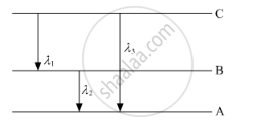
(ii) Find the relation between three wavelengths λ1, λ2 and λ3 from the energy-level diagram shown below.
Calculate the radius of second Bohr orbit in hydrogen atom from the given data.
Mass of electron = 9.1 x 10⁻³¹kg
Charge on the electron = 1.6 x 10⁻¹⁹ C
Planck’s constant = 6.63 x 10⁻³⁴ J-s.
Permittivity of free space = 8.85 x 10⁻¹² C2/Nm2
What is the energy in joules, required to shift the electron of the hydrogen atom from the first Bohr orbit to the fifth Bohr orbit and what is the wavelength of the light emitted when the electron returns to the ground state? The ground state electron energy is –2.18 × 10⁻¹¹ ergs.
Draw a neat, labelled energy level diagram for H atom showing the transitions. Explain the series of spectral lines for H atom, whose fixed inner orbit numbers are 3 and 4 respectively.
If the photon of the wavelength 150 pm strikes an atom and one of its inner bound electrons is ejected out with a velocity of 1.5 × 10⁷ ms–1, calculate the energy with which it is bound to the nucleus.
The gravitational attraction between electron and proton in a hydrogen atom is weaker than the Coulomb attraction by a factor of about 10−40. An alternative way of looking at this fact is to estimate the radius of the first Bohr orbit of a hydrogen atom if the electron and proton were bound by gravitational attraction. You will find the answer interesting.
if `E_p` and `E_k` represent potential energy and kinetic energy respectively, of an orbital electron, then, according to B9hr's theory:
a)`E_k = -E_p"/"2`
b) `E_k = -E_p`
c) `E_k = -2E_p`
d) `E_k = 2E_p`
Using Bohr’s postulates, obtain the expression for total energy of the electron in the nth orbit of hydrogen atom.
The numerical value of ionization energy in eV equals the ionization potential in volts. Does the equality hold if these quantities are measured in some other units?
When a photon stimulates the emission of another photon, the two photons have
(a) same energy
(b) same direction
(c) same phase
(d) same wavelength
Find the wavelength of the radiation emitted by hydrogen in the transitions (a) n = 3 to n= 2, (b) n = 5 to n = 4 and (c) n = 10 to n = 9.
When a photon is emitted by a hydrogen atom, the photon carries a momentum with it. (a) Calculate the momentum carries by the photon when a hydrogen atom emits light of wavelength 656.3 nm. (b) With what speed does the atom recoil during this transition? Take the mass of the hydrogen atom = 1.67 × 10⁻²⁷ kg. (c) Find the kinetic energy of recoil of the atom.
According to Bohr, 'Angular momentum of an orbiting electron is quantized'. What is meant by this statement?
Mention demerits of Bohr’s Atomic model.
According to Bohr's model of hydrogen atom, an electron can revolve round a proton indefinitely, if its path is ______.
The energy of an electron in hth orbit of hydrogen atom is –13.6/n2ev energy required to excite the electron from the first orbit to the third orbit is
For the ground state, the electron in the H-atom has an angular momentum = h, according to the simple Bohr model. Angular momentum is a vector and hence there will be infinitely many orbits with the vector pointing in all possible directions. In actuality, this is not true ______.
Use Bohr's postulate to prove that the radius of nth orbit in a hydrogen atom is proportional to n2.
The electron in a hydrogen atom first jumps from the third excited state to the second excited state and subsequently to the first excited state. The ratio of the respective wavelengths, λ1/λ2, of the photons emitted in this process is ______.
The energy of an electron in the first Bohr orbit of the H-atom is −13.6 eV. The energy value of an electron in the excited state of Li2+ is ______.
In hydrogen atom, transition from the state n = 6 to n = 1 results in ultraviolet radiation. Infrared radiation will be obtained in the transition ______.
According to Bohr's theory, the radius of the nth Bohr orbit of a hydrogen like atom of atomic number Z is proportional to ______.
An electron in a hydrogen atom has an energy of -3.4 eV. The difference between its kinetic and potential energy is ______.
Using Bohr’s Theory of hydrogen atom, obtain an expression for the velocity of an electron in the nth orbit of an atom.
On the basis of Bohr's theory, derive an expression for the radius of the nth orbit of an electron of hydrogen atom.
The de Broglie wavelength of an electron in the first Bohr’s orbit of hydrogen atom is equal to ______.
For the reaction \[\ce{2NO2 (g) ⇌ N2O4(g)}\], when ΔS = −176.0 JK−1 and ΔH = −57.8 kj mol−1, the magnitude of ΔG at 298 K for the reaction is ______ kJ mol−1. (Nearest integer)
What happens when an electron makes the transition described by Bohr’s third postulate?
