Advertisements
Advertisements
प्रश्न
Find distance between point A(7, 5) and B(2, 5).
Advertisements
उत्तर
Let A(x1, y1) = A(7, 5) and B(x2, y2) = B(2, 5)
∴ By distance formula,
d(A, B) = `sqrt((x_2 - x_1)^2 + (y_2 - y_1)^2`
= `sqrt((2 - 7)^2 + (5 - 5)^2`
= `sqrt((-5)^2 + 0^2)`
= `sqrt(25)`
= 5 cm
∴ The distance between points A and B is 5 cm.
संबंधित प्रश्न
If the point A(0, 2) is equidistant from the points B(3, p) and C(p, 5), find p. Also, find the length of AB.
Show that four points (0, – 1), (6, 7), (–2, 3) and (8, 3) are the vertices of a rectangle. Also, find its area
If the opposite vertices of a square are (1, – 1) and (3, 4), find the coordinates of the remaining angular points.
Find all possible values of y for which the distance between the points A(2, –3) and B(10, y) is 10 units.
For what values of k are the points (8, 1), (3, –2k) and (k, –5) collinear ?
Find the distance between the following pair of point.
P(–5, 7), Q(–1, 3)
If A and B are the points (−6, 7) and (−1, −5) respectively, then the distance
2AB is equal to
Find the distance of the following point from the origin :
(13 , 0)
Find the distance between the following point :
(Sin θ - cosec θ , cos θ - cot θ) and (cos θ - cosec θ , -sin θ - cot θ)
Prove that the points (0 , 2) , (1 , 1) , (4 , 4) and (3 , 5) are the vertices of a rectangle.
From the given number line, find d(A, B):

Prove that the points P (0, -4), Q (6, 2), R (3, 5) and S (-3, -1) are the vertices of a rectangle PQRS.
The points A (3, 0), B (a, -2) and C (4, -1) are the vertices of triangle ABC right angled at vertex A. Find the value of a.
Show that the quadrilateral with vertices (3, 2), (0, 5), (- 3, 2) and (0, -1) is a square.
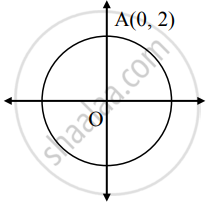
Seg OA is the radius of a circle with centre O. The coordinates of point A is (0, 2) then decide whether the point B(1, 2) is on the circle?
The point which divides the lines segment joining the points (7, -6) and (3, 4) in ratio 1 : 2 internally lies in the ______.
Find a point which is equidistant from the points A(–5, 4) and B(–1, 6)? How many such points are there?
The points A(–1, –2), B(4, 3), C(2, 5) and D(–3, 0) in that order form a rectangle.
The centre of a circle is (2a, a – 7). Find the values of a if the circle passes through the point (11, –9) and has diameter `10sqrt(2)` units.
The distance of the point (5, 0) from the origin is ______.
