Advertisements
Advertisements
प्रश्न
Find distance between point A(–1, 1) and point B(5, –7):
Solution: Suppose A(x1, y1) and B(x2, y2)
x1 = –1, y1 = 1 and x2 = 5, y2 = –7
Using distance formula,
d(A, B) = `sqrt((x_2 - x_1)^2 + (y_2 - y_1)^2`
∴ d(A, B) = `sqrt(square +[(-7) + square]^2`
∴ d(A, B) = `sqrt(square)`
∴ d(A, B) = `square`
Advertisements
उत्तर
Suppose A(x1, y1) and B(x2, y2)
x1 = –1, y1 = 1 and x2 = 5, y2 = – 7
Using distance formula,
d(A, B) = `sqrt((x_2 - x_1)^2 + (y_2 - y_1)^2`
∴ d(A, B) = \[\sqrt{\boxed{[5 - (-1)]^2} + [(-7) + \boxed{-1}]^2}\]
∴ d(A, B) = `sqrt(6^2 + (-8)^2`
∴ d(A, B) = `sqrt(36 + 64)`
∴ d(A, B) = \[\sqrt{\boxed{100}}\]
∴ d(A, B) = \[\boxed{10 \phantom{.}\text{units}}\]
APPEARS IN
संबंधित प्रश्न
Find the distance between the following pairs of points:
(a, b), (−a, −b)
If Q (0, 1) is equidistant from P (5, –3) and R (x, 6), find the values of x. Also, find the distances QR and PR.
If a ≠ b ≠ 0, prove that the points (a, a2), (b, b2) (0, 0) will not be collinear.
The value of 'a' for which of the following points A(a, 3), B (2, 1) and C(5, a) a collinear. Hence find the equation of the line.
If the point A(x, 2) is equidistant from the points B(8, –2) and C(2, –2), find the value of x. Also, find the length of AB.
Using the distance formula, show that the given points are collinear:
(–1, –1), (2, 3) and (8, 11)
Using the distance formula, show that the given points are collinear:
(–2, 5), (0, 1) and (2, –3)
Find the distance between the following pair of points.
R(0, -3), S(0, `5/2`)
Find the distance between the following pairs of point.
W `((- 7)/2 , 4)`, X (11, 4)
A line segment of length 10 units has one end at A (-4 , 3). If the ordinate of te othyer end B is 9 , find the abscissa of this end.
Find the distance between the following pair of points:
`(sqrt(3)+1,1)` and `(0, sqrt(3))`
A point P (2, -1) is equidistant from the points (a, 7) and (-3, a). Find a.
Point P (2, -7) is the centre of a circle with radius 13 unit, PT is perpendicular to chord AB and T = (-2, -4); calculate the length of AB.
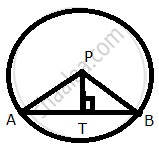
Calculate the distance between A (5, -3) and B on the y-axis whose ordinate is 9.
Show that each of the triangles whose vertices are given below are isosceles :
(i) (8, 2), (5,-3) and (0,0)
(ii) (0,6), (-5, 3) and (3,1).
Show that the point (11, –2) is equidistant from (4, –3) and (6, 3).
Show that P(–2, 2), Q(2, 2) and R(2, 7) are vertices of a right angled triangle.
Using distance formula decide whether the points (4, 3), (5, 1) and (1, 9) are collinear or not.
The coordinates of the point which is equidistant from the three vertices of the ΔAOB as shown in the figure is ______.

∆ABC with vertices A(–2, 0), B(2, 0) and C(0, 2) is similar to ∆DEF with vertices D(–4, 0), E(4, 0) and F(0, 4).
