Advertisements
Advertisements
प्रश्न
Ayush starts walking from his house to office. Instead of going to the office directly, he goes to a bank first, from there to his daughter’s school and then reaches the office. What is the extra distance travelled by Ayush in reaching his office? (Assume that all distances covered are in straight lines). If the house is situated at (2, 4), bank at (5, 8), school at (13, 14) and office at (13, 26) and coordinates are in km.
Advertisements
उत्तर
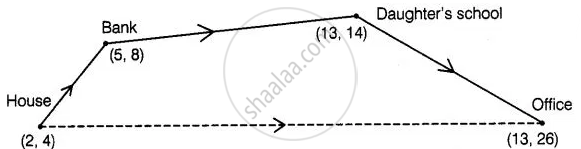
By given condition, we drawn a figure in which every place are indicated with his coordinates and direction also.
We know that,
Distance between two points (x1, y1) and (x2, y2),
d = `sqrt((x_2 - x_1)^2 + (y_2 - y_1)^2`
Now, distance between house and bank
= `sqrt((5 - 2)^2 + (8 - 4)^2`
= `sqrt((3)^2 + (4)^2`
= `sqrt(9 + 16)`
= `sqrt(25)`
= 5
Distance between bank and daughter's school
= `sqrt((13 - 5)^2 + (14 - 8)^2`
= `sqrt((8)^2 + (6)^2`
= `sqrt(64 + 36)`
= `sqrt(100)`
= 10
Distance between daughter's school and office
= `sqrt((13 - 13)^2 + (26 - 14)^2`
= `sqrt(0 + (12)^2`
= 12
Total distance (House + Bank + School + Office) travelled
= 5 + 10 + 12
= 27 units
Distance between house to offices
= `sqrt((13 - 2)^2 + (26 - 4)^2`
= `sqrt((11)^2 + (22)^2`
= `sqrt(121 + 484)`
= `sqrt(605)`
= 24.59
= 24.6 km
So, extra distance travelled by Ayush in reaching his office = 27 – 24.6 = 2.4 km.
Hence, the required extra distance travelled by Ayush is 2.4 km.
APPEARS IN
संबंधित प्रश्न
Find the point on the x-axis which is equidistant from (2, -5) and (-2, 9).
If a≠b≠0, prove that the points (a, a2), (b, b2) (0, 0) will not be collinear.
Find the distance of the following points from the origin:
(iii) C (-4,-6)
If the point A(x,2) is equidistant form the points B(8,-2) and C(2,-2) , find the value of x. Also, find the value of x . Also, find the length of AB.
If P (x , y ) is equidistant from the points A (7,1) and B (3,5) find the relation between x and y
Determine whether the point is collinear.
R(0, 3), D(2, 1), S(3, –1)
Show that the points A(1, 2), B(1, 6), C(1 + 2`sqrt3`, 4) are vertices of an equilateral triangle.
Find the distance between the following pairs of point in the coordinate plane :
(13 , 7) and (4 , -5)
A line segment of length 10 units has one end at A (-4 , 3). If the ordinate of te othyer end B is 9 , find the abscissa of this end.
Prove taht the points (-2 , 1) , (-1 , 4) and (0 , 3) are the vertices of a right - angled triangle.
Prove that the points (1 , 1) , (-1 , -1) and (`- sqrt 3 , sqrt 3`) are the vertices of an equilateral triangle.
From the given number line, find d(A, B):

A point P (2, -1) is equidistant from the points (a, 7) and (-3, a). Find a.
Points A (-3, -2), B (-6, a), C (-3, -4) and D (0, -1) are the vertices of quadrilateral ABCD; find a if 'a' is negative and AB = CD.
Find the point on y-axis whose distances from the points A (6, 7) and B (4, -3) are in the ratio 1: 2.
Find distance of point A(6, 8) from origin
Show that the point (11, – 2) is equidistant from (4, – 3) and (6, 3)
What is the distance of the point (– 5, 4) from the origin?
Show that points A(–1, –1), B(0, 1), C(1, 3) are collinear.
The distance of the point (5, 0) from the origin is ______.
