Advertisements
Advertisements
प्रश्न
Find the area of the region bounded by the curve y2 = 4x and the line x = 3
Advertisements
उत्तर
The region bounded by the parabola, y2 = 4x, and the line, x = 3, is the area OACO.
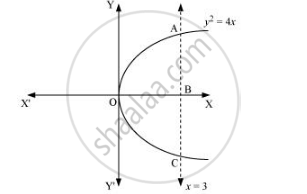
The area OACO is symmetrical about x-axis.
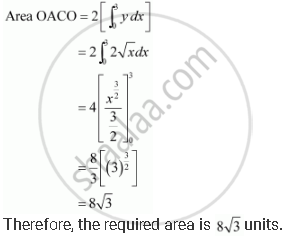
∴ Area of OACO = 2 (Area of OAB)
APPEARS IN
संबंधित प्रश्न
Find the area of the region in the first quadrant enclosed by the x-axis, the line y = x and the circle x2 + y2 = 32.
Find the area of the region bounded by y2 = 9x, x = 2, x = 4 and the x-axis in the first quadrant.
Find the area of the region bounded by the ellipse `x^2/16 + y^2/9 = 1.`
Find the area of the region bounded by the ellipse `x^2/4 + y^2/9 = 1.`
Find the area of the region bounded by the parabola y = x2 and y = |x| .
Find the area enclosed between the parabola y2 = 4ax and the line y = mx
Find the area of the region {(x, y) : y2 ≤ 4x, 4x2 + 4y2 ≤ 9}
Find the area of the region bounded by the parabola y2 = 16x and the line x = 4.
Find the area of the region bounded by the following curves, the X-axis and the given lines: 2y + x = 8, x = 2, x = 4
Find the area of the region bounded by the parabola y2 = 4x and the line x = 3.
Area of the region bounded by y = x4, x = 1, x = 5 and the X-axis is _______.
Fill in the blank :
Area of the region bounded by x2 = 16y, y = 1, y = 4 and the Y-axis, lying in the first quadrant is _______.
State whether the following is True or False :
The area bounded by the curve x = g (y), Y-axis and bounded between the lines y = c and y = d is given by `int_"c"^"d"x*dy = int_(y = "c")^(y = "d") "g"(y)*dy`
Choose the correct alternative:
Area of the region bounded by y2 = 16x, x = 1 and x = 4 and the X axis, lying in the first quadrant is ______
State whether the following statement is True or False:
The area bounded by the curve y = f(x) lies on the both sides of the X-axis is `|int_"a"^"b" "f"(x) "d"x| + |int_"b"^"c" "f"(x) "d"x|`
The area of the circle x2 + y2 = 16 is ______
The area of the region lying in the first quadrant and bounded by the curve y = 4x2, and the lines y = 2 and y = 4 is ______
Find the area of the region bounded by the curve y = `sqrt(2x + 3)`, the X axis and the lines x = 0 and x = 2
`int_0^log5 (e^xsqrt(e^x - 1))/(e^x + 3)` dx = ______
`int "e"^x ((sqrt(1 - x^2) * sin^-1 x + 1)/sqrt(1 - x^2))`dx = ________.
The area of the region bounded by the X-axis and the curves defined by y = cot x, `(pi/6 ≤ x ≤ pi/4)` is ______.
The area bounded by the X-axis, the curve y = f(x) and the lines x = 1, x = b is equal to `sqrt("b"^2 + 1) - sqrt(2)` for all b > 1, then f(x) is ______.
The area of the region bounded by the curve y = x IxI, X-axis and the ordinates x = 2, x = –2 is ______.
Which equation below represents a parabola that opens upward with a vertex at (0, – 5)?
The equation of curve through the point (1, 0), if the slope of the tangent to t e curve at any point (x, y) is `(y - 1)/(x^2 + x)`, is
The area included between the parabolas y2 = 4a(x +a) and y2 = 4b(x – a), b > a > 0, is
Area bounded by the curves y = `"e"^(x^2)`, the x-axis and the lines x = 1, x = 2 is given to be α square units. If the area bounded by the curve y = `sqrt(ℓ "n"x)`, the x-axis and the lines x = e and x = e4 is expressed as (pe4 – qe – α), (where p and q are positive integers), then (p + q) is ______.
The area bounded by the curve | x | + y = 1 and X-axis is ______.
The area bounded by the curve `y = 3/2sqrtx`, the line x = 1 and x-axis is ______ sq. units.
Why cannot a curve crossing the \[x\]-axis within \[a,b\] be integrated directly from \[a\] to \[b\] to obtain total area?
A curve crosses the \[x\]-axis, forming area \[A_1\] below the axis and area \[A_2\] above the axis. What is its total area?
Which integral represents the enclosed area of the ellipse after using the positive first-quadrant value of \[y\]?
