Advertisements
Advertisements
प्रश्न
Find the area of the region bounded by the ellipse `x^2/16 + y^2/9 = 1.`
Advertisements
उत्तर
Given equation of ellipse `x^2/16 + y^2/9 = 1`
The given ellipse is symmetric about both axes and has identical x and y axes.
`= y^2/9 = 1 - x^2/16`
`= y = pm 3/4 (sqrt(16 - x^2))`
Area enclosed by the ellipse = 4(Area of sector) = 4(Area OAC)
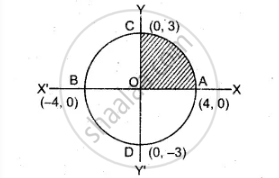
Ellipse in the first quadrant `= 4 int_0^4 y dx = int_0^4 3/4 sqrt(16 - x^2) dx`
Let `x = 4 sin theta ; dx = 4 cos theta d theta`
Hence, when x = 0, `theta = 0 ;` when x = 4, `theta = pi/2`
Required Area `= (4 xx 3)/4 int_0^(pi//2) sqrt(16 - 16 sin^2 theta). 4 cos theta d theta.`
`= 3 int_0^(pi/2) 4sqrt(1 - sin^2 theta). 4 cos theta d theta`
`= 48 int_0^(pi/2) cos^2 theta d theta`
`= 24 int_0^(pi/2) (1 + cos 2 theta)d theta`
`= 24 [theta + (sin 2 theta)/2]_0^(pi/2)`
`= 12π square unit
APPEARS IN
संबंधित प्रश्न
Using integration find the area of the triangle formed by positive x-axis and tangent and normal of the circle
`x^2+y^2=4 at (1, sqrt3)`
Find the area under the given curve and given line:
y = x4, x = 1, x = 5 and x-axis
Sketch the graph of y = |x + 3| and evaluate `int_(-6)^0 |x + 3|dx`
Using the method of integration find the area of the triangle ABC, coordinates of whose vertices are A(2, 0), B (4, 5) and C (6, 3).
Using integration, find the area of the region {(x, y) : x2 + y2 ≤ 1 ≤ x + y}.
Using integration find the area of the triangle formed by negative x-axis and tangent and normal to the circle `"x"^2 + "y"^2 = 9 "at" (-1,2sqrt2)`.
Find the area of the region bounded by the following curves, the X-axis and the given lines: y = x4, x = 1, x = 5
The area of the region bounded by y2 = 4x, the X-axis and the lines x = 1 and x = 4 is _______.
State whether the following is True or False :
The area bounded by the curve y = f(x), X-axis and lines x = a and x = b is `|int_"a"^"b" f(x)*dx|`.
If the curve, under consideration, is below the X-axis, then the area bounded by curve, X-axis and lines x = a, x = b is positive.
State whether the following is True or False :
The area of the portion lying above the X-axis is positive.
Solve the following :
Find the area of the region bounded by the curve xy = c2, the X-axis, and the lines x = c, x = 2c.
Choose the correct alternative:
Area of the region bounded by the curve y = x3, x = 1, x = 4 and the X-axis is ______
Choose the correct alternative:
Using the definite integration area of the circle x2 + y2 = 16 is ______
Choose the correct alternative:
Area of the region bounded by the curve x2 = 8y, the positive Y-axis lying in the first quadrant and the lines y = 4 and y = 9 is ______
Choose the correct alternative:
Area of the region bounded by x = y4, y = 1 and y = 5 and the Y-axis lying in the first quadrant is ______
The area of the region lying in the first quadrant and bounded by the curve y = 4x2, and the lines y = 2 and y = 4 is ______
The area of the region x2 = 4y, y = 1 and y = 2 and the Y axis lying in the first quadrant is ______
Find the area of the region bounded by the curve 4y = 7x + 9, the X-axis and the lines x = 2 and x = 8
Find area of the region bounded by the curve y = – 4x, the X-axis and the lines x = – 1 and x = 2
Find area of the region bounded by the parabola x2 = 36y, y = 1 and y = 4, and the positive Y-axis
Find the area of the region bounded by the curve x = `sqrt(25 - y^2)`, the Y-axis lying in the first quadrant and the lines y = 0 and y = 5
The area enclosed between the curve y = loge(x + e) and the coordinate axes is ______.
The ratio in which the area bounded by the curves y2 = 8x and x2 = 8y is divided by the line x = 2 is ______
`int "e"^x ((sqrt(1 - x^2) * sin^-1 x + 1)/sqrt(1 - x^2))`dx = ________.
Which equation below represents a parabola that opens upward with a vertex at (0, – 5)?
The equation of curve through the point (1, 0), if the slope of the tangent to t e curve at any point (x, y) is `(y - 1)/(x^2 + x)`, is
Area bounded by the curves y = `"e"^(x^2)`, the x-axis and the lines x = 1, x = 2 is given to be α square units. If the area bounded by the curve y = `sqrt(ℓ "n"x)`, the x-axis and the lines x = e and x = e4 is expressed as (pe4 – qe – α), (where p and q are positive integers), then (p + q) is ______.
If area of the region bounded by y ≥ cot( cot–1|In|e|x|) and x2 + y2 – 6 |x| – 6|y| + 9 ≤ 0, is λπ, then λ is ______.
The figure shows as triangle AOB and the parabola y = x2. The ratio of the area of the triangle AOB to the area of the region AOB of the parabola y = x2 is equal to ______.

The area (in sq. units) of the region {(x, y) : y2 ≥ 2x and x2 + y2 ≤ 4x, x ≥ 0, y ≥ 0} is ______.
The area bounded by the curve | x | + y = 1 and X-axis is ______.
If the area enclosed by y = f(x), X-axis, x = a, x = b and y = g(x), X-axis, x = a, x = b are equal, then f(x) = g(x).
The area enclosed by the parabola x2 = 4y and its latus rectum is `8/(6m)` sq units. Then the value of m is ______.
Find the area of the region lying in the first quadrant and bounded by y = 4x2, x = 0,y = 2 and y = 4.
Which strips are considered for the area bounded by \[y=f(x)\], the \[x\]-axis, and the ordinates \[x=a\] and \[x=b\]?
Which integral gives the area bounded by \[x=g(y)\], the \[y\]-axis, and the horizontal lines \[y=c\] and \[y=d\]?
Which antiderivative is used in evaluating \[\int \sqrt{a^2-x^2}\,dx\] for the ellipse area?
