Advertisements
Advertisements
प्रश्न
Fill in the blanks according to the example given below
| tiny | tinier | tiniest |
| big | ______ | biggest |
| sleepy | sleepier | ______ |
| ______ | lovelier | loveliest |
| ______ | later | ______ |
| round | ______ | ______ |
| small | ______ | ______ |
| good | ______ | best |
Advertisements
उत्तर
| tiny | tinier | tiniest |
| big | bigger | biggest |
| sleepy | sleepier | sleepiest |
| lovely | lovelier | loveliest |
| late | later | latest |
| round | rounder | roundest |
| small | smaller | smallest |
| good | better | best |
APPEARS IN
संबंधित प्रश्न
Why were the children confused about their grandfather’s claims about the war?
What lesson is learnt from the poem?
Make a critical appreciation of the short story, “A Horse and Two Goats,” by R.K. Narayan.
(A) As soon as she reached home, she learnt that she had to leave for London.
(B) Hardly……………………………
Fill in each of the numbered blanks with the correct form of the word given in brackets. Do not copy the passage, but write in the correct serial order the word or phrase appropriate to the blank space.
Example:
(0) One morning, I (0) ……. (see) the python curled up on the dressing table.
Answer: saw.
It was (1) ……. (gaze) at its own reflection in the mirror. I (2) ……… (go) for grandfather, but by the time we (3) ……… (return) to the room, the python (4) …….. (move) on. He was seen in the garden, and once the cook saw him, (5) ……… (crawl) up the ladder to the roof. Then we (6) …….. (find) him on the dressing table again, (7) (admire) himself in the mirror. “He’s trying to look better for Aunt Mabel,” I said. I (8) ……. (regret) this remark immediately because grandmother overheard it and held up my pocket money for the rest of the week!
What difference did you notice between the reaction of the adults and the children when faced with danger?
Do you think it is important to preserve languages?
How is Satyajit's financial crash introduced to the reader?
The extract deals with the atmosphere of two homes. Collect the words associated with - Garden.
Relate the life-story of Caesar, rearranging the facts in a proper sequence in the form of a flow chart:
- Caesar begins to upset things at home
- Neighbour flings a stick at Caesar
- Young crow is saved by the narrator
- Caesar begins to trouble neighbours
- The crow is named Caesar
- Caesar passes away
- Caesar objects to being caged.
Create a poster for the following.
Say ‘No to Drugs’ – Design a poster for it is not more than 50 words. You may use slogans/ phrases.
Make the children write their own story. The following questions will help them to write. Ask them to gather information from their parents before writing and to give a title.
- When were you born?
- Where were you born?
- What is your father’s name and what is he?
- What is your mother’s name and what is she?
- What is your birth order?
- Do you have any nickname, if yes, reason for that?
- An interesting incident that happened in your life.
Write a narrative paragraph on Kamarajar, using the given information and add more information on your own.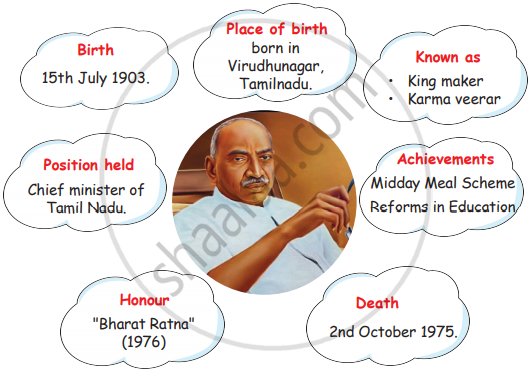
Rewrite the passage below using capital letters where necessary
one saturday afternoon amarjit and his little sister rani went for a picnic to india gate. there they saw ducks, water and their friend raj
The ______of robbers escaped.
The old man shouted ______[loud]
Why did one of the girls wail?
Which of the following lines tells us that the poet Wordsworth carried a mental picture of the daffodils?
Write an original short story that begins with the following words:
My mother stopped suddenly at the doorway and stared in amazement at ..........
Observe the tourist leaflets given and answer the following.
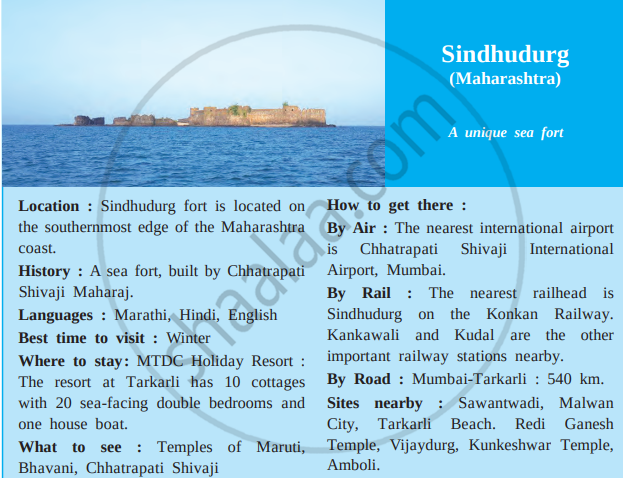

- Which places do these leaflets describe?
- What are the main points given in each leaflet?
- How can one reach Tadoba?
- Which is the best season to visit Tadoba? Why?
- List tourism-related words, e.g., tourist, booking etc.
