Advertisements
Advertisements
प्रश्न
Explain in detail an adiabatic process.
Advertisements
उत्तर
Adiabatic process: This is a process in which no heat flows into or out of the system (Q = 0). But the gas can expand by spending its internal energy or gas can be compressed through some external work. So the pressure, volume and temperature of the system may change in an adiabatic process.
For an adiabatic process, the first law becomes ∆U = W.
This implies that the work is done by the gas at the expense of internal energy or work is done on the system which increases its internal energy.
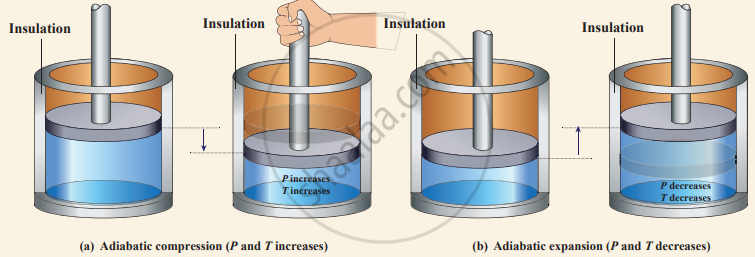
Adiabatic compression and expansion
The adiabatic process can be achieved by the following methods:
(i) Thermally insulating the system from surroundings so that no heat flows into or out of the system; for example when the thermally insulated cylinder of gas is compressed (adiabatic compression) or expanded (adiabatic expansion) as shown in the Figure.
(ii) If the process occurs so quickly that there is no time to exchange heat with surroundings even though there is no thermal insulation. A few examples are shown in Figure.
The equation of state for an adiabatic process is given by
PVγ = constant ...............(1)
Here γ is called adiabatic exponent `(γ = "C"_"p"/"C"_"v")` which depends on the nature of the gas. The equation (1) implies that if the gas goes from an equilibrium state (Pi, Vi) to another equilibrium state (Pf, Vf) adiabatically then it satisfies the relation
`"P"_"i""V"_"i"^γ = "P"_"f""V"_"f"^γ` ..........(2)
The PV diagram for an adiabatic process is also called adiabat. But actually, the adiabatic curve is steeper than an isothermal curve.
We can also rewrite the equation (1) in terms of T and V. From the ideal gas equation, the pressure P = `(μ"RT")/"V"`.
Substituting this equation in equation (1), we have
`(μ"RT")/"V""V^γ` = constant (or) `"T"/"V""V"^γ = "constant"/(μ"R")`
Note here that is another constant. So it can be written as
TVγ-1 = constant ..................(3)
The equation implies that if the gas goes from an initial equilibrium state (Ti, Vi) to final equilibrium state (Tf, Vf) adiabatically then it satisfies the relation
`"T"_"i""V"_"i"^(γ - 1) = "T"_"f""V"_"f"^(γ - 1)` .......(4)
The equation of state for the adiabatic process can also be written in terms of T and P as
TγP1-γ = constant ............(5)

PV diagram for adiabatic expansion and adiabatic compression
APPEARS IN
संबंधित प्रश्न
Heating a gas in a constant volume container is an example of which process?
Draw a p-V diagram showing negative work with varying pressure.
Explain the thermodynamics of the isobaric process.
Apply first law for an isobaric process.
Draw the PV diagram for the isothermal process.
Can the given heat energy be completely converted to work in a cyclic process? If not, when can the heat can completely converted to work?
Derive the work done in an isothermal process.
In an adiabatic expansion of the air, the volume is increased by 4%, what is the percentage change in pressure? (For air γ = 1.4)
Assertion: Equal volumes of monatomic and polyatomic gases are adiabatically compressed separately to equal compression ratio `("P"_2/"P"_1)`. Then monatomic gas will have greater final volume.
Reason: Among ideal gases, molecules of a monatomic gas have the smallest number of degrees of freedom.
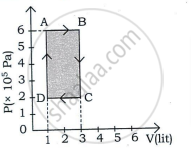
An ideal gas is taken through a cyclic process ABCDA as shown in figure. The net work done by the gas during the cycle is ______.