Advertisements
Advertisements
प्रश्न
Explain the thermodynamics of the isobaric process.
Advertisements
उत्तर
- A thermodynamic process that is carried out at constant pressure i.e., Δp = 0 is called the isobaric process.
- For an isobaric process, none of the quantities ΔU, Q, and W is zero.
- The temperature of the system changes, i.e., ΔT ≠ 0.
- The energy exchanged is used to do work as well as to change internal energy causing an increase in temperature. Thus, Q = ΔU + W.
- As work is done volume changes during the process.
- Heat exchanged in case of an isobaric process:
a. Consider an ideal gas undergoing volume expansion at constant pressure.
b. If Vi and Ti are its volume and temperature in the initial state of a system and Vf and Tf are its final volume and temperature respectively, the work done in the expansion is given by,
W = pdV = p(Vf – Vi) = nR(Tf – Ti) ….(1)
c. Also, the change in the internal energy of a system is given by, ΔU = nCVΔT = nCV(Tf – Ti) ….(2)
Where, CV is the specific heat at constant volume, and ΔT = (Tf – Ti) is the change in its temperature during the isobaric process.
d. According to the first law of thermodynamics, the heat exchanged is given by, Q = ΔU + W
Using equations (1) and (2) we get,
Q = nCV(Tf – Ti) + nR(Tf – Ti)
∴ Q = (nCV + nR) (Tf – Ti)
∴ Q = nCp(Tf – Ti) .............(∵ Cp = CV + R)
Where, Cp is the specific heat at constant pressure. - The p-V diagram for an isobaric process is called isobar. It is shown in the figure below.

APPEARS IN
संबंधित प्रश्न
An ideal gas is taken through an isothermal process. If it does 2000 J of work on its environment, how much heat is added to it?
Draw a p-V diagram showing positive work at constant pressure.
An ideal gas of volume 2 L is adiabatically compressed to (1/10)th of its initial volume. Its initial pressure is 1.01 x 10⁵ Pa, calculate the final pressure. (Given 𝛾 = 1.4)
Explain graphically (i) positive work with varying pressure, (ii) negative work with varying pressure, and (iii) positive work at constant pressure.
When food is cooked in a vessel by keeping the lid closed, after some time the steam pushes the lid outward. By considering the steam as a thermodynamic system, then in the cooking process
When you exercise in the morning, by considering your body as a thermodynamic system, which of the following is true?
The V-T diagram of an ideal gas which goes through a reversible cycle A→B→C→D is shown below. (Processes D→A and B→C are adiabatic)

The corresponding PV diagram for the process is (all figures are schematic)
Give an expression for work done in an isothermal process.
Apply first law for an adiabatic process.
Apply first law for an isobaric process.
Draw the PV diagram for the isothermal process.
In a petrol engine, (internal combustion engine) air at atmospheric pressure and temperature of 20°C is compressed in the cylinder by the piston to `1/8` of its original volume. Calculate the temperature of the compressed air. (For air γ = 1.4)
An ideal gas is taken in a cyclic process as shown in the figure. Calculate
- work done by the gas
- work done on the gas
- Net work done in the process

For a given ideal gas 6 × 10⁵ J heat energy is supplied and the volume of gas is increased from 4 m3 to 6 m3 at atmospheric pressure. Calculate
- the work done by the gas
- change in internal energy of the gas
- graph this process in PV and TV diagram
An ideal gas is expanded isothermally from volume V1 to volume V2 and then compressed adiabatically to original volume V1. If the initial pressure is P1, the final pressure is P3 and net work done is W, then ____________.
An ideal gas is made to go from a state A to stale B in the given two different ways (see figure) (i) an isobaric and then an isochoric process and (ii) an isochoric and then an isobaric process. The work done by gas in the two processes are W1 and W2 respectively. Then,

One mole of an ideal gas with `gamma` = 1.4 is adiabatically compressed so that its temperature rises from 27° C to 47° C. The change in the internal energy of the gas is (R = 8.3 J/mol.K) ____________.
In which of the following processes, beat is neither absorbed nor released by a system?
An ideal gas A and a real gas B have their volumes increased from V to 2V under isothermal conditions. The increase in internal energy ____________.
Assertion: Equal volumes of monatomic and polyatomic gases are adiabatically compressed separately to equal compression ratio `("P"_2/"P"_1)`. Then monatomic gas will have greater final volume.
Reason: Among ideal gases, molecules of a monatomic gas have the smallest number of degrees of freedom.
An ideal gas is compressed to half its initial volume by means of several processes. Which of the process results in the maximum work done on the gas?
We consider a thermodynamic system. If `Delta"U"` represents the increase in its internal energy and W the work done by the system, which of the following statements is true?
Ideal gas for which 'ϒ' = 1.5 is suddenly compressed to `1/4`th of its initial volume. The ratio of 4 the final pressure to the initial pressure is ______.
`(ϒ = "C"_"p"/"C"_"v")`
Which of the following processes is reversible?
Consider P-V diagram for an ideal gas shown in figure.
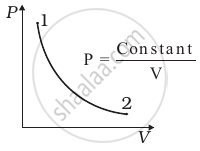
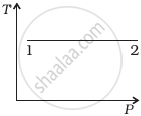
Out of the following diagrams (figure), which represents the T-P diagram?
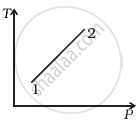 (i) |
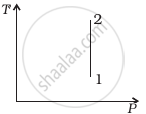 (ii) |
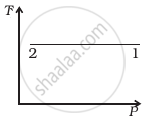 (iii) |
 (iv) |
Explain the thermodynamic process.
In a cyclic process, if ΔU = internal energy, W = work done, Q = Heat supplied then ______.
