Advertisements
Advertisements
प्रश्न
Apply first law for an isobaric process.
Advertisements
उत्तर
The first law of thermodynamics for an isobaric process is given by ∆U = Q – P∆V
W = P∆V, ∆U = `"Q" - μ"RT"_"f" [1 - "T"_"i"/"T"_"f"]`
APPEARS IN
संबंधित प्रश्न
A thermodynamic system is taken from an original state to an intermediate state by the linear process shown in Figure
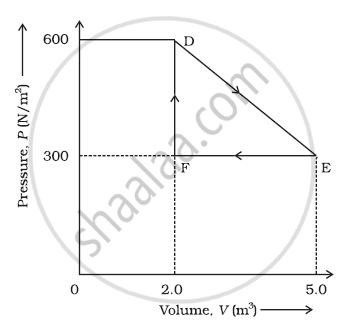
Its volume is then reduced to the original value from E to F by an isobaric process. Calculate the total work done by the gas from D to E to F
Explain the cyclic process.
3 mole of a gas at temperature 400 K expands isothermally from an initial volume of 4 litres to a final volume of 8 litres. Find the work done by the gas. (R = 8.31 J mol-1 K-1)
In an isochoric process, we have ____________.
Give an expression for work done in an isothermal process.
Draw the PV diagram for the isochoric process.
Can the given heat energy be completely converted to work in a cyclic process? If not, when can the heat can completely converted to work?
Consider the following cyclic process consist of isotherm, isochoric and isobar which is given in the figure.

Draw the same cyclic process qualitatively in the V-T diagram where T is taken along the x-direction and V is taken along the y-direction. Analyze the nature of heat exchange in each process.
An ideal gas is compressed to half its initial volume by means of several processes. Which of the process results in the maximum work done on the gas?
In a certain thermodynamical process, the pressure of a gas depends on its volume as kV3. The work done when the temperature changes from 100°C to 300°C will be ______ nR, where n denotes number of moles of a gas.
