Advertisements
Advertisements
प्रश्न
Draw the PV diagram for the isobaric process.
Advertisements
उत्तर

APPEARS IN
संबंधित प्रश्न
A thermodynamic system is taken from an original state to an intermediate state by the linear process shown in Figure
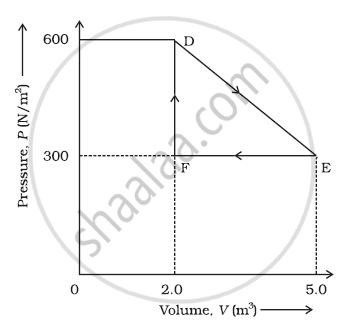
Its volume is then reduced to the original value from E to F by an isobaric process. Calculate the total work done by the gas from D to E to F
Draw a p-V diagram of the irreversible process.
Apply first law for an adiabatic process.
Apply first law for an isobaric process.
Draw the PV diagram for the isochoric process.
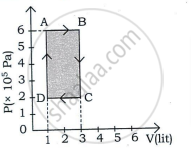
An ideal gas is taken in a cyclic process as shown in the figure. Calculate
- work done by the gas
- work done on the gas
- Net work done in the process

In which of the following processes, beat is neither absorbed nor released by a system?
An ideal gas A and a real gas B have their volumes increased from V to 2V under isothermal conditions. The increase in internal energy ____________.
Give any two types of a thermodynamic process.
An ideal gas is taken through a cyclic process ABCDA as shown in figure. The net work done by the gas during the cycle is ______.