Advertisements
Advertisements
प्रश्न
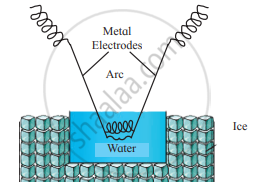
Draw labelled diagram of Bredig’s arc method.
Advertisements
उत्तर
APPEARS IN
संबंधित प्रश्न
Define the following with a suitable example, of each:
Gel
Choose the correct option.
The size of colloidal particles lies between ______.
Distinguish between lyophobic and lyophilic sols.
Identify the dispersed phase and dispersion medium in the following colloidal dispersions.
- milk
- blood
- printing ink
- fog
Draw labelled diagram Tyndall effect.
Froth and whipped cream are examples of ____________.
Which one of the following methods is used to make platinum sol?
Which of the following is multimolecular colloid?
In coagulation of positively charged ferric hydroxide sol, the most and least effective ions are ____________ and ____________ respectively.
Which of the following is a heterogeneous mixture?
Which of the following statements is CORRECT?
The precipitation power of an electrolyte increases with ______.
Which of the following is NOT true for lyophilic colloids?
Smoke is an example of ____________.
Which of the following is multimqlecular colloid?
The movement of colloidal particles towards respective electrode under electric field is called ______.
In which of the following sols there is low affinity between dispersed phase and dispersion medium?
Some colloids are stable by their nature, i.e., gels, alloys, and solid foams. Gelatin and jellies are two common examples of a gel. The solid and liquid phases in a gel are interdispersed with both phases being continuous. In most systems, the major factor influencing the stability is the charge on the colloidal particles. If a particular ion is preferentially adsorbed on the surface of the particles, the particles in suspension will repel each other, thereby preventing the formation of aggregates that are larger than colloidal dimensions. The ion can be either positive or negative depending on the particular colloidal system, i.e., air bubbles accumulate negative ions, sulphur particles have a net negative charge in a sulphur sol, and the particles in a metal hydroxide sol are positively charged. Accumulation of charge on a surface is not an unusual phenomenon-dust is attracted to furniture surfaces by electrostatic forces. When salts are added to lyophobic colloidal systems the colloidal particles begin to form larger aggregates and a sediment forms as they settle. This phenomenon is called flocculation, and the suspension can be referred to as flocculated, or colloidally unstable. If the salt is removed, the suspension can usually be restored to its original state; this process is called deflocculation or peptization. The original and restored colloidal systems are called deflocculated, peptized, or stable sols.
Why does a small amount of salt have such a dramatic effect on the stability of a lyophobic colloidal system? The answer lies in an understanding of the attractive and repulsive forces that exist between colloidal particles. Van der Waals forces are responsible for the attractions, while the repulsive forces are due to the surface charge on the particles. In a stable colloid, the repulsive forces are of greater magnitude than the attractive forces. The magnitude of the electrical repulsion is diminished by addition of ionized salt, which allows the dispersed particles to aggregate and flocculate. River deltas provide an example of this behaviour. A delta is formed at the mouth of a river because the colloidal clay particles are flocculated when the freshwater mixes with the salt water of the ocean.
Gelatin is a _________ colloidal system.
Some colloids are stable by their nature, i.e., gels, alloys, and solid foams. Gelatin and jellies are two common examples of a gel. The solid and liquid phases in a gel are interdispersed with both phases being continuous. In most systems, the major factor influencing the stability is the charge on the colloidal particles. If a particular ion is preferentially adsorbed on the surface of the particles, the particles in suspension will repel each other, thereby preventing the formation of aggregates that are larger than colloidal dimensions. The ion can be either positive or negative depending on the particular colloidal system, i.e., air bubbles accumulate negative ions, sulphur particles have a net negative charge in a sulphur sol, and the particles in a metal hydroxide sol are positively charged. Accumulation of charge on a surface is not an unusual phenomenon-dust is attracted to furniture surfaces by electrostatic forces. When salts are added to lyophobic colloidal systems the colloidal particles begin to form larger aggregates and a sediment forms as they settle. This phenomenon is called flocculation, and the suspension can be referred to as flocculated, or colloidally unstable. If the salt is removed, the suspension can usually be restored to its original state; this process is called deflocculation or peptization. The original and restored colloidal systems are called deflocculated, peptized, or stable sols.
Why does a small amount of salt have such a dramatic effect on the stability of a lyophobic colloidal system? The answer lies in an understanding of the attractive and repulsive forces that exist between colloidal particles. Van der Waals forces are responsible for the attractions, while the repulsive forces are due to the surface charge on the particles. In a stable colloid, the repulsive forces are of greater magnitude than the attractive forces. The magnitude of the electrical repulsion is diminished by addition of ionized salt, which allows the dispersed particles to aggregate and flocculate. River deltas provide an example of this behaviour. A delta is formed at the mouth of a river because the colloidal clay particles are flocculated when the freshwater mixes with the salt water of the ocean.
Settling down of colloidal particles to form a suspension is called ______.
What happens when electric field is applied to colloidal solution?
How does the precipitation of colloidal smoke take place in Cottrell precipitator?
Colloids can
The coagulation of 200 ML of position sol took place when 0.73 HCL was added to its without changing the volume much. The flocculation value of HCL for the colloid is.
Which of the following substances will precipitate the negatively charge emulsion
Which of the following is most powerful to coagulate the negative colloid?
Van Arkel's method of purification of metals involves converting the metal to a ______.
