Advertisements
Advertisements
प्रश्न
Discuss in pairs or in small groups.
People with foibles are often not conscious of them.
Advertisements
उत्तर
Yes, I do think and I agree with this fact that People with Foibles are often not conscious about them. The reason being that they are ignorant and unaware of it and they continue with their eccentricity, Blissfully, ignorant of them.
APPEARS IN
संबंधित प्रश्न
Answer the following question in 120-150 words :
Nancy Lammeter is a typical country girl. Comment.
Read the following passage and do the activities:
A1 True or False:
Rewrite the following statements and state whether they are ‘true’ or ‘false’.
(i) Mashelkar’s mother did menial work to bring him up.
(ii) Mashelkar’s father died when he was twelve.
(iii) Mashelkar was born in a very rich family.
(iv) Tatas added much value to Mashelkar’s life.
I start with my greatest guru-my mother. I was born in a very poor family and my father died when I was six. We moved to Mumbai and my mother did menial work to bring me up. Two meals a day was a tough challenge. I studied under street lights and I walked barefoot until, I think, I was twelve. I remember when I passed the seventh standard and I wanted to go into the eighth standard, our poverty was such that even to secure 21 rupees for secondary school admission became a big challenge. We had to borrow from a lady, who was a housemaid in Chaupati in Mumbai. That was the tough life I had.
In fact, I remember, my passing the SSC Examination-i.e. 11th standard. Those days it used to be not 10th standard or 12th standard but 11th standard. I stood 11th among 1,35,000 but I was about to leave higher education and find a job. What helped me was the scholarship by Sir Dorab Tata Trust. It was just 60 rupees per month and would you believe that 60 rupees per month from Tatas added so much value to my life that I have been able to stand here today before you to speak to you.
I am on the Board of Tatas now and it is very interesting that the same Bombay House where I used to go to collect that 60 rupees per month now one goes and sits there like a Director on the Board of Tata Motors. The turn that these 40 years have taken is very interesting. It has all been possible because of the chance I got to do higher studies at the insistence of my mother. She gave me the values of my life. She was one of the noblest parents I have met in my life.
So, my greatest guru was my mother. My second guru was Principal Bhave, about whom I made a mention earlier. He taught us Physics. Because it was a poor school, I remember, it had to innovate to convey to the young students the message of Science.
A2 Complete:
Complete the following sentences and write:
(i) Mashelkar was inspired by his greatest guru _______
(ii) Mashelkar studied under _______
(iii) Principal Bhave taught _______
(iv) The scholarship by _______ Trust helped him in higher education.
A3 Find the meaning:
Choose the appropriate meaning of the underlined words from the given alternatives:
(i) We moved to Mumbai and my mother did menial work.
(a) skilled
(b) hard
(c) unskilled
(d) of low status
(ii) Because it was a poor school, it had to innovate to convey to the young students the message of science.
(a) do a cheap experiment
(b) introduce new things
(c) avoid
(d) try hard
(iii) I got to do higher studies at the insistence of my mother.
(a) firm saying
(b) being inspired
(c) being inspected
(d) being instigated
(iv) That was the tough life I had.
(a) difficult
(b) soft
(c) cheap
(d) simple
A4 Match:
Match the following sentences with their tags:
| 'A' | 'B' | ||
| (i) | I stood 11th among 1,35,000 |
(a) | aren’t I? |
| (ii) | I am on the Board of Tatas | (b) | didn’t we? |
| (iii) | It was a poor school | (c) | didn’t I? |
| (iv) | We moved to Mumbai | (d) | wasn’t it? |
A5 Personal Response:
“Mother is the greatest Guru.” Discuss.
Read the following passage carefully and complete the activities given below:
B.1) Order :
Rearrange the following sentences in proper order:
(i) Hanmant joined engineering.
(ii) Hanmant got his Diploma and secured a job in Philips.
(iii) Hanmant migrated to Pune when he was in class VI.
(iv) Hanmant took up a painting job to earn.
Hanmant Gaikwad was born in Koregaon in Satara district.
“My native place is Rahimatpur, around 10 km from Koregaon. My father was a clerk in the court and we lived in a small, rented house.”
Hanmant was a brilliant student especially good in mathematics. When he was in class six, the family shifted to Pune. They lived in Phugewadi near Dapodi in a tiny one-room house-10 by 10 feet. At this point, Hanmant realized the difference between himself and those who had money.
Hanmant was then studying at Modern High School. He needed one rupee to buy a bus ticket to and from the everyday. Even that was hard to come by.
Despite the hardships, Hanmant secured 88% in class 10. Hanmant completed his diploma and joined Philips as a trainee. But he wasn’t happy with the work he got there.
The natural choice for a diploma engineer is to go for a B.Tech. But engineering colleges charge hefty fees. At the time, the family’s only source of income was a teacher’s salary of Rs. 2,300 a month……….
And then I decided to also do some earning. “Khud Ka Kamana Chalu Kiya”.
Hanmant took up painting jobs and quickly discovered it was excellent business.
The young engineering student paid his own fees from the third year onwards. But his lifestyle remained frugal.
Life was getting better, but Hanmant had his sights set higher. In the final year of engineering, he was attracted to the writings of Swami Vivekananda.
“I felt Ki Kuch Alag Karna hai. What should I do, I did not know but in 1993 I formed an organization-Bharat Vikas Pratisthan.”
B.2) Complete :
|
Hardships faced by Hanmant Gaikwad |
B.3) Rewrite the following sentence choosing the appropriate word/s for the underlined word/s :
(i) His lifestyle remained frugal:
(a) simple
(b) meager
(c) extravagant
(ii) Despite hardships, Hanmant secured 88% in class X:
(a) In spite of
(b) Regarding
(c) Affected
(iii) Hanmant took up painting jobs:
(a) assumed
(b) to continue
(c) accepted
(iv) Hanmant had his sights set higher:
(a) looked ahead
(b) lofty ambitions
(c) looked above
B.4) Do as Directed
(i) Hanmant secured 88% in class X. ( Begin the sentence as-88%....................)
(ii) In the final year of engineering, he was attracted towards the writings of Swami Vivekananda. (Frame a ‘Wh-question’ to get the underlined part as the answer.)
B.5) “Today’s hardships lead to tomorrow’s success”-Justify.
Tick the statement if its true.
Rajendra Deshpande was a historian.
The text is an excerpt from Sesame and Lilies which consists of two essays, primarily, written for delivery as public lectures in 1864. Identify the features that fit the speech mode. Notice the sentence patterns.
How is the essence of the poem captured in the lines 'two tickets to Happiness'?
' Kummi', ' ghumar' and 'dandia' are some dance forms mentioned in the text. Make an inventory of folk dance forms in the different regions of the country.
Read the following statement and mark those that apply to you.
I have a small group of close friends and have no wish to interact with anyone else.
Answer in your own words.
How did the plants respond when Revathi played her favourite tune?
Pick out a word from the poem to complete the sentence meaningfully.
Handicapped people should never be ______. (ignored and avoided)
Doctors who do special advanced study of specific parts of the body have special terms.
In your group try to match the specialist doctors with who / what they treat.
| Specialists | Who/What they treat | ||
| 1. | Dentist | a. | bone |
| 2. | Cardiologist | b. | brain/with spine |
| 3. | Ophthalmologist | c. | small kids |
| 4. | Orthopedic | d. | teeth |
| 5. | Pediatrician | e. | animals/birds |
| 6. | Neurologist | f. | eye |
| 7. | Veterinarian | g. | heart |
Discuss orally in your class.
In what subjects is knowledge of mathematics used, at school level, and college/university level? Name them.
Did you know maths is used in music and poetry also? Can you tell how?
Answer the following question in short.
Why did Pundit Shahane visit Vijaynagar?
Find a suitable object for each comparison.
Answer the following question in one sentence.
What does the title of the poem say?
Write a short note on the following:
Sujata’s offering
List the phrases that indicate sorrow or pain.
Read the following sentence aloud. Write who said it and to whom.
“I would rather not go to the party.”
Write a character sketch of each of the animals. Write about their actions and thoughts and the qualities that emerge through them. You may present the sketch in the form of a graphic.
Think of a play/skit which you have seen enacted on the stage and which has impressed you. Write the following details about it.
| Name of the play/skit: | ______________ |
| Important characters: | ______________ |
| Any famous actors/actresses: | ______________ |
| Theme: | ______________ |
| Climax: | ______________ |
| Ending: | ______________ |
| Use of lights and special effects if any: | ______________ |
| Use of background music and sound effects if any: | ______________ |
| Use of sets: | ______________ |
| The costumes, make up, etc. of the characters: | ______________ |
| How well the actors present the play and behave on the stage: | ______________ |
| Your own opinion about the play: | ______________ |
Complete the following phrases with the help of the poem.
- ______ music
- ______ rivers
- ______ breeze
- ______ lake
- ______ citron-trees
Read: ‘The Open Window’ by H. H. Munro (Saki).
Gather more information about cold winters in Russia.
Did Gopal Bhand have a field?
Guess the meaning of the following word.
postponed
The following thing is mentioned in the poem.
Classify it as a happy and sad thing.
flowers - falling leaves
How was Gulliver tied down on the seashore?
If you were to grow very tiny like a Lilliputian, what are the things you would like to do? Write about any three of these things.
Who is a ‘netizen’?
Guess the meaning of the following word.
pleasing
Identify the character or speaker.
He imprisoned the spirits in the bodies of large trees.
Identify the character or speaker.
I will tie you neck and feet together.
He decided to find his cousins’ home without their help. He asked the policeman for information in Italian because he.
Write down the word that alliterate in the poetic line below
Festival of Flowers.
Identify the character/speaker.
I'll see you later at the Queen's croquet game.
Identify the character/speaker.
Wake up. You've been sleeping for too long.
Read the following lines and answer the questions.
It isn’t an instantaneous thing
Born of despair with a sudden spring
- What does ‘it’ refer to?
- What does ‘born of despair mean’?
Work in pairs and answer the following.
Pick out the alliterated words.
Identify the speaker/character.
He'll have to be given artificial respiration and kept warm.
It is a problem for sea turtles to come ashore because ______.
Read the questions related to the three sports stars you have read about and tick the appropriate boxes.
 |
 |
 |
|
| 1. Who won the Olympic 2016 silver medal in badminton? | |||
| 2. Who is the role model for her siblings? | |||
| 3. Whose mother tongue is Tamil? | |||
| 4. Whose attitude is 'never-say-die spirit'? | |||
| 5. Which player works in the Police Department? | |||
| 6. Which player holds the record for the highest individual score in cricket? |
How did Gulliver overcome the adversity?
The land was wet and green.
Find the rhyming word from the poem.
Language - ______.
Jaswant was captured alive.
_______ is our culture.
Write the correct form for the present perfect tense.
They ______ (start) playing.
Anbu was talented in catching______.
Divide the following word.
butter
Write the word under the correct group and divide it.
bullet
candle
bat
title
ball
tiffin
 |
 |
 |
______are the real wealth.
Who made the tree become a monster?
Read the passage and colour one bag each time you read.
There lived a poor but an honest farmer in a village. He supported himself, his wife and seven children using his small piece of land.
One day while he was walking in his field, he found a bag of gold.
He took it home and showed it to his wife. His wife told him to keep some of the gold. He told his wife that honesty is the best policy. He tried to find the person who lost it. At last, he found that the owner of the bag and gave it back. The rich man took the bag and thanked him.

How can we do our work better?
What would you have done if your grandmother would have slipped?

Who was Nokomis?
What did the library door say?
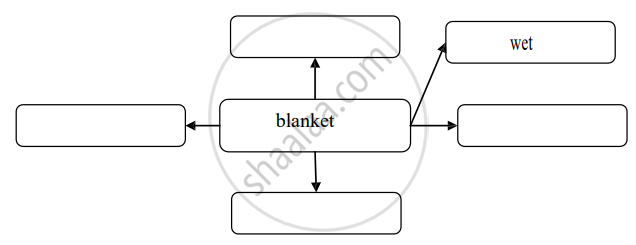
Write the related words as shown in the example.
Read the extract and complete the activities given below:
|
The call of the seas has always found an echo in me. Not being rich enough to roam in a private yacht, I have taken the poor man's way out. I swim across them. I have always been fascinated by the Indian ocean, whether at Mumbai, at Puri or at Gopalpur. I have swam in all these places and have felt the thrill. But the idea of swimming the Palk Strait did not occur to me until after I swam in the English channel. Steeped in the history and tradition of this nation, practically unconquered. teaming with hair-raising hazards, the sea between India and Sri Lanka had all the elements of challenge, danger and difficulty that tempted me. By the way, for preparation, I continued a strict and rigorous course of training which began in 1960. I also had to collect a comprehensive range of facts and information about this sea. Neither of these was easy. Despite all the information I had gathered, I soon found that very little was known about the Palk Strait, especially about the tides and currents. Everything about the English channel is known-there is the Channel Swimming Association, there are trained pilots there are wants to be hired, accurate weather forecasts, dependable tide tables and every other form of assistance was readily available. All that one needed was money. Here in the Palk Strait one has to find out firstly from where information could be obtained and then decide how much of it could be incorrect or misleading! |
A1. Rewrite the following as per their sequence in the extract: (2)
- I also had to collect a comprehensive range of facts and information about this sea.
- I have swam in all these places and have felt the thrill.
- All that one needed was money.
- Despite all the information I had gathered, I soon found that very little was known about the Palk Strait.
A2. Explain: (2)
What does the writer man by saving, "Steeped in the history and tradition of this nation, practically unconquered, teeming with hair-raising hazards, the sea between India and Sri Lanka had all the elements of challenge, danger and difficulty that tempted me"?
A3. Give reason: (2)
The narrator had an intense desire to swim in the Palk Strait. Explain the reasons for it.
A4. Personal Response: (2)
Do you like to have an adventurous life? Express your opinion.
A5. Grammar:
Do as directed: (2)
- Very little was known about the Palk Strait. (Rewrite as a negative sentence)
- I had to collect a comprehensive range of facts. (Rewrite the sentence beginning with 'A comprehensive ........)
A6. Vocabulary: (2)
Give the synonyms of the following words:
- rigorous - ______
- thrill - ______
