Advertisements
Advertisements
प्रश्न
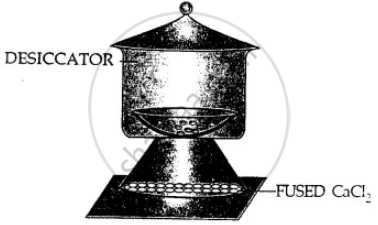
Differentiate the function of concentrated sulphuric acid as a drying agent & as a dehydrating agent. Is fused calcium chloride a dehydrating or a desiccating agent. Give reasons.
Advertisements
उत्तर
Sulphuric acid (cone.) acts as drying agent when it removes water from other substances i.e. for drying gases.
Cone, sulphuric acid acts as dehydrating agent when it removes chemically combined water from compounds due to it strong affinity for water.
\[\ce{\underset{\text{ethanol}}{C2H5OH} + ->[Conc. H2SO4][dehydrating agent] \underset{\text{ethene}}{C2H4} +\underset{\text{water}}{H2O}}\]
Cone. H2SO4 has removed H20 from ethanol and changed it to ethene. Fused calcium chloride [CaCl2] is desiccating agent as it is drying the substance.
APPEARS IN
संबंधित प्रश्न
Define water of crystallization. Give two examples with formulae.
Give one word for the following statement:
A property due to which a substance absorbs water without dissolving.
What are hydrous substances? Explain with examples.
Match the substances in List I with the appropriate answer in List II.
| List I | List II |
| 1. Green vitriol | A: Permanent hardness in water |
| 2. Paint | B: Hygroscopic |
| 3. Magnesium chloride | C: Temporary hardness in water |
| 4. Magnesium bicarbonate | D: Heptahydrate |
| 5. Calcium oxide | E: Colloidal |
Select the correct answer from the choice given in the options.
An anhydrous crystal _____.
Name or state the following:
A liquid hydroscopic substance.
Differentiate between the following:
Deliquescent salt and hygroscopic salt
Match the following
| 1. | Blue vitriol | CaSO4.2H2O |
| 2. | Gypsum | CaO |
| 3. | Deliquescence | CuSO4.5H2O |
| 4. | Hygroscopic | NaOH |
The molecular formula of green vitriol is MgSO4.7H2O.
What happens when MgSO4.7H2O is heated? Write the appropriate equation?
