Advertisements
Advertisements
प्रश्न
Differentiate between the following:
Turgidity and Flaccidity
Advertisements
उत्तर
| Turgidity | Flaccidity | ||
| 1. | It is the state of a cell in which the cell cannot accommodate any more water and is fully distended. | 1. | It is the condition in which the cell content is shrunken and the cell is not tight. |
| 2. | The availability of sufficient water causing the cells to become charged with water with its walls in a state of tension making the cells rigid and stretched. | 2. | The unavailability of sufficient water causes the cells to become weak and soft due to decreased turgor pressure. |
| 3. | This condition causes wilting in plants. | 3. | This condition makes plants stiff and erect. |
संबंधित प्रश्न
A plant cell may burst when :
Give scientific reasons : Balsam plants wilt during mid-day even if the soil is well watered.
Fig. represents aprocess in plants. The set up was placed in bright sunlight. Answer the following questions:
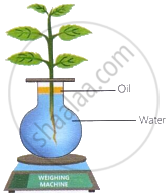
-
- Name the physiological process depicted in the figure.
- Why was oil added to the water?
- When placed in bright sunlight for four hours, what do you observe with regard to the initial and final weight of the plant? Give a suitable reason for your answer.
- What happens to the level of water when this setup is placed in:
- Humid conditions?
- Windy conditions?
- Mention any three adaptations found in plants to overcome the process mentioned in (a).
- Explain the term ‘Guttation’.
Give the equivalent term for the following:
The condition in which the cell contents are shrunken.
Differentiate between the following:
Turgor pressure and wall pressure
What is the difference between ‘flaccid’ and ‘turgid’? Give one example of flaccid condition in plants.
Give reason for the following:
It is better to transplant seedlings in a flower-bed in the evening and not in the morning.
Differentiate between the following
Turgor pressure and Root pressure
Give Technical Term for the following.
A cell in a fully extended condition.
The hydrostatic pressure of the cell sap on the cell wall is called ______.
