Advertisements
Advertisements
प्रश्न
Differentiate between the following:
Turgor pressure and wall pressure
Advertisements
उत्तर
| Turgor Pressure | Wall Pressure | ||
| 1. | The hydrostatic pressure that endosmosis creates against the cell wall is known as turgor pressure. | 1. | The force that the cell wall exerts against turgor pressure is known as wall pressure. |
| 2. | Turgor pressure acts on the cell wall. | 2. | Cell wall pressure is generated by the cell wall. |
| 3. | Turgor pressure keeps plant stems upright, expands leaves and aids in the opening and closing of stomata, among other things. | 3. | Wall pressure maintains cell and plant structure. |
| 4. | The direction of Turgor pressure is towards the outside. | 4. | The direction of wall pressure is towards the inside of the cell. |
संबंधित प्रश्न
Give scientific reasons : Balsam plants wilt during mid-day even if the soil is well watered.
Give the equivalent term for the following:
The condition in which the cell contents are shrunken.
Give the equivalent term for the following:
Loss of water through a cut stem.
A leaf cell of a water plant was placed in a liquid other than pond water. After sometime, it assumed a shape as shown below:
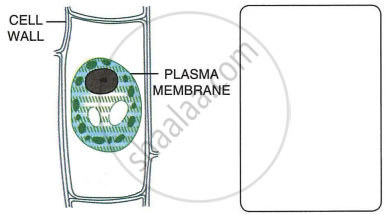
- Give the term for the state of the cell it has acquired.
- Name the structure which acts as a selectively permeable membrane.
- Comment on the nature (tonicity) of the liquid surrounding the cell.
- Name any one feature of this plant cell which is not present in an animal cell.
- Redraw in the space provided, the diagram of the cell if it is soon placed in ordinary water for some time.
Distinguish between the following:
Flaccid condition and turgid condition
Name the following:
The condition in which the contents of a cell exert pressure against the cell wall making it distended.
Fill in the Blank
Wilting and drooping of leaves is due to loss of ________.
When the cells of a plant are fully distended, the condition is called ______.
The figure given below is a diagrammatic representation of a part of the cross-section of the root in the root hair zone. Study the same and then answer the questions that follow:

- The parts labelled as 1, 2, 3 and 4 are:
- Root hair, Xylem vessel, Soil particles, Cortex respectively.
- Xylem vessel, Soil particles, Root hair, Cortex respectively.
- Root hair, Xylem vessel, Cortex, Soil particles respectively.
- Cortex, Soil particles, Xylem vessel, Root hair respectively.
- The process that enables the passage of water from soil into the root hair is:
- Diffusion
- Active transport
- Osmosis
- Passive absorption
- The kind of force which exists between a liquid and any surface is called as:
- Cohesive force
- Adhesive force
- Capillarity
- Suction force
- The kind of force between the same kind of liquid molecules is:
- Capillary force
- Transpirational pull
- Adhesive force
- Cohesive force
- Sometimes exudation of water occurs from the margin of the leaves in the early morning or night. It is termed as:
- Transpiration
- Guttation
- Bleeding
- Osmosis
