Advertisements
Advertisements
प्रश्न
Give suitable biological reasons for the following statement:
Root hairs become flaccid and droop when excess fertilizers are added to the moist soil around them.
Advertisements
उत्तर
Due to excessive application of fertilizers in the agricultural fields it damage the roots by plasmolysis process which results into flaccidity of root hairs.
APPEARS IN
संबंधित प्रश्न
The diagram given below represents a plant cell after being placed in a strong sugar solution. Study the diagram and answer the questions that follow:

- What is the state of the cell shown in the diagram?
- Name the structure that acts as a selectively permeable membrane.
- Label the parts numbered 1 to 4 in the diagram.
- How can the above cell be brought back to its original condition? Mention the scientific term for the recovery of the cell.
- State any two features of the above plant cell which is not present in animal cells.
A plant cell may burst when :
The state of a cell in which the cell wall is rigid and stretched by the increase in volume due to the absorption of water is called.
Give reason for the following:
It is better to transplant seedlings in a flower-bed in the evening and not in the morning.
Give reason for the following:
A plant cell, when kept in a hypertonic salt solution for about 30 minutes, turns flaccid.
Differentiate between:
Turgid and Flaccid.
The below diagram represents a plant cell after being placed in a strong sugar solution. Guidelines 1 to 5 indicate the following: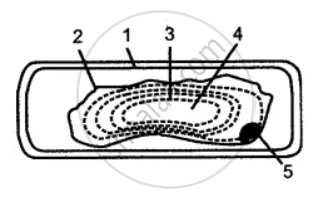
1. Cell wall
2. Plasma membrane.
3. Protoplasm
4. Large vacuole
5. Nucleus
Study the diagram and answer the questions that follow :
(i) What is the state of the cell shown in the diagram?
(ii) Name the structure which acts as a selectively permeable membrane.
(iii) If the cell had been placed in distilled water instead of a strong sugar solution which features: would not have been present?
(iv) If the cell in the diagram possessed chloroplasts where would these be present?
(v) Name any one feature of this plant cell which is not present in animal cells.
Deplasmolysis occurs when a plasmolysed cell is placed in ______.
Give the equivalent term for the following:
Pressure exerted by the cell contents on the cell wall.
