Advertisements
Advertisements
प्रश्न
Determine the volume contraction of a solid copper cube, 10 cm on an edge, when subjected to a hydraulic pressure of 7.0 ×10⁶ Pa.
Advertisements
उत्तर १
Length of an edge of the solid copper cube, l = 10 cm = 0.1 m
Hydraulic pressure, p = 7.0 ×10⁶ Pa
Bulk modulus of copper, B = 140 × 109 Pa
Bulk Modulus, `B = p/((triangle V)/V)`
Where
`(triangle V)/V` = Volumetric strain
ΔV = Change in volume
V = Original volume.
`triangleV = (pV)/B`
Original volume of the cube, `V = beta`
`:.triangle V = (pl^3)/B`
`= (7xx10^6xx (0.1)^3)/(140xx10^9)`
= 5 x 10⁻⁸ m3
= 5 x 10⁻² cm-3
Therefore, the volume contraction of the solid copper cube is 5 × 10⁻² cm–3.
उत्तर २
Here a side of copper cube a = 10 cm, hence volume V = a3 = 10-3 m3 , hydraulic pressure applied p = 7.0 x 10⁶ Pa and from table we find that bulk modulus of copper B = 140 G Pa = 140 x 109 Pa.
Using the relation `B = p/((triangle V)/V)` we have decreased in
volume `triangle V = (PV)/B`
`:. triangleV = (7.0xx10^6xx10^(-3))/(140xx10^9) = 5xx 10^(-8) m^3 = 5 xx 10^(-2) cm^3`
APPEARS IN
संबंधित प्रश्न
A steel cable with a radius of 1.5 cm supports a chairlift at a ski area. If the maximum stress is not to exceed 108 N m–2, what is the maximum load the cable can support?
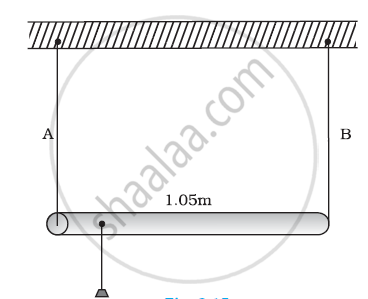
A rod of length 1.05 m having negligible mass is supported at its ends by two wires of steel (wire A) and aluminium (wire B) of equal lengths as shown in Figure. The cross-sectional areas of wires A and B are 1.0 mm2 and 2.0 mm2, respectively. At what point along the rod should a mass m be suspended in order to produce (a) equal stresses and (b) equal strains in both steel and aluminium wires.
When a block a mass M is suspended by a long wire of length L, the elastic potential potential energy stored in the wire is `1/2` × stress × strain × volume. Show that it is equal to `1/2` Mgl, where l is the extension. The loss in gravitational potential energy of the mass earth system is Mgl. Where does the remaining `1/2` Mgl energy go ?
The yield point of a typical solid is about 1%. Suppose you are lying horizontally and two persons are pulling your hands and two persons are pulling your legs along your own length. How much will be the increase in your length if the strain is 1% ? Do you think your yield point is 1% or much less than that?
A steel blade placed gently on the surface of water floats on it. If the same blade is kept well inside the water, it sinks. Explain.
When a metal wire is stretched by a load, the fractional change in its volume ∆V/V is proportional to
A load of 10 kg is suspended by a metal wire 3 m long and having a cross-sectional area 4 mm2. Find (a) the stress (b) the strain and (c) the elongation. Young modulus of the metal is 2.0 × 10¹¹ N m−2.
Answer in one sentence.
How should be a force applied on a body to produce shearing stress?
A charged particle is moving in a uniform magnetic field in a circular path of radius R. When the energy of the particle becomes three times the original, the new radius will be ______.
A spiral spring is stretched by a weight. The strain will be:
Modulus of rigidity of ideal liquids is ______.
A mild steel wire of length 2L and cross-sectional area A is stretched, well within elastic limit, horizontally between two pillars (Figure). A mass m is suspended from the mid point of the wire. Strain in the wire is ______.

Consider two cylindrical rods of identical dimensions, one of rubber and the other of steel. Both the rods are fixed rigidly at one end to the roof. A mass M is attached to each of the free ends at the centre of the rods.
Consider a long steel bar under a tensile stress due to forces F acting at the edges along the length of the bar (Figure). Consider a plane making an angle θ with the length. What are the tensile and shearing stresses on this plane

- For what angle is the tensile stress a maximum?
- For what angle is the shearing stress a maximum?
A steel wire having a radius of 2.0 mm, carrying a load of 4 kg, is hanging from a ceiling. Given that g = 3.1πms-2, what will be the tensile stress that would be developed in the wire?
The area of the cross-section of the rope used to lift a load by a crane is 2.5 × 10⁻⁴m2. The maximum lifting capacity of the crane is 10 metric tons. To increase the lifting capacity of the crane to 25 metric tons, the required area of cross-section of the rope should be ______.
(take g = 10 ms-2)
Strain is defined as the ratio of ______.
