Advertisements
Advertisements
प्रश्न
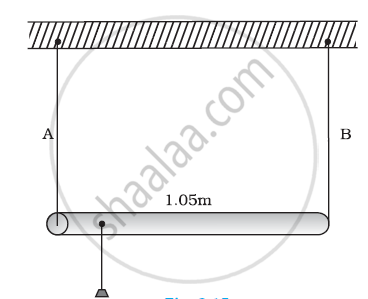
A rod of length 1.05 m having negligible mass is supported at its ends by two wires of steel (wire A) and aluminium (wire B) of equal lengths as shown in Figure. The cross-sectional areas of wires A and B are 1.0 mm2 and 2.0 mm2, respectively. At what point along the rod should a mass m be suspended in order to produce (a) equal stresses and (b) equal strains in both steel and aluminium wires.
Advertisements
उत्तर १
a) 0.7 m from the steel-wire end
Let a small mass m be suspended to the rod at a distance y from the end where wire A is attached.
Stress in wire = `"Force"/"Area"= F/a`
If the two wires have equal stresses, then:
`F_1/a_1 = F_2/a_2`
Where
F1 = Force exerted on the steel wire
F2 = Force exerted on the aluminum wire
`F_1/F_2 = a_1/a_2 = 1/2` ....(i)
The situation is shown in the following figure.
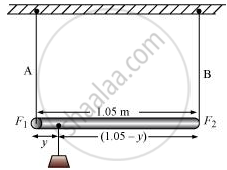
Taking torque about the point of suspension, we have:
`F_1y =F_2(1.05 - y)`
`F_1/F_2 = (1.05 - y)/y` ...(ii)
Using equations (i) and (ii), we can write:
`(1.05 -y)/y = 1/5`
2(1.05 - y) = y
2.1 - 2y = y
3y = 2.1
`:. y = 0.7 m`
In order to produce an equal stress in the two wires, the mass should be suspended at a distance of 0.7 m from the end where wire A is attached.
b) 0.432 m from the steel-wire end
Cross-sectional area of wire A, a1 = 1.0 mm2 = 1.0 × 10⁻⁶ m2
Cross-sectional area of wire B, a2 = 2.0 mm2 = 2.0 × 10⁻⁶ m2
Young’s modulus for steel, Y1 = 2 × 10¹¹ Nm–2
Young’s modulus for aluminium, Y2 = 7.0 ×10¹⁰ Nm–2
`"Young's modulus" = "Stress"/"Strain"`
Strain = `"Stress"/"Young's modulus" = a/Y`
`(F_1/a_1)/Y_1 = (F_2/a_2)/Y_2`
`F_1/F_2 = a_1/a_2 Y_1/Y_2 = 1/2 xx (2xx10^11)/(7xx10^10) =10/7` ....(iii)
Taking torque about the point where mass m, is suspended at a distance y1 from the side where wire A attached, we get:
F1y1 = F2 (1.05 – y1)
`F_1/F_2 = (1.05 - y_1)/y_1` ...(iii)
Using equations (iii) and (iv), we get:
`((1.05 - y_1))/y_1 = 10/7`
`7(1.05 - y_1) = 10y_1`
17y_1 = 7.35
`:.y_1 = 0.432`
In order to produce an equal strain in the two wires, the mass should be suspended at a distance of 0.432 m from the end where wire A is attached
उत्तर २
For steel wire A, l1=l; Az = 1 mm2; Y1= 2 x 10¹¹ Nm-2
For aluminium wire B, l2 = l; A2 = 2mm2; Y2 = 7 x 10¹⁰ Nm-2
a) Let mass m be suspended from the rod at distance x from the end where wire A is connected. Let F1 and F2be the tensions in two wires and there is equal stress in two wires, then
`F_1/A_1 = F_2/A_2 =>F_1/F_2 =A_1/A_2 = 1/2` ... (i)
Taking moment of forces about the point of suspension of mass from the rod, we have
`F_1x = F_2(1.05 - x) or (1.05 - x)/x = F_1/F_2 = 1/2`
or 2.10 - 2x = x => x = 0.70 m = 70 cm
(b) Let mass m be suspended from the rod at distance x from the end where wire A is connected. Let F1 and F2be the tension in the wires and there is equal strain in the two wires i.e.,
`F_1/(A_1Y_1) = F_2/(A_2Y_2) => F_1/F_2 = (A_1Y_1)/(A_2Y_2) = 1/2 xx (2xx10^11)/(7xx10^10) = 10/7`
As the rod is stationary, so `F_1x = F_2(1.05 - x)` or
`(1.05 - x)/x = F_1/F_2 = 10/7`
=>10x =7.35 - 7x or x= 0.4324 m = 43.2 cm
APPEARS IN
संबंधित प्रश्न
Determine the volume contraction of a solid copper cube, 10 cm on an edge, when subjected to a hydraulic pressure of 7.0 ×10⁶ Pa.
A mild steel wire of length 1.0 m and cross-sectional area 0.50 × 10⁻² cm2 is stretched, well within its elastic limit, horizontally between two pillars. A mass of 100 g is suspended from the mid-point of the wire. Calculate the depression at the midpoint.
When the skeleton of an elephant and the skeleton of a mouse are prepared in the same size, the bones of the elephant are shown thicker than those of the mouse. Explain why the bones of an elephant are thicker than proportionate. The bones are expected to withstand the stress due to the weight of the animal.
A heave uniform rod is hanging vertically form a fixed support. It is stretched by its won weight. The diameter of the rod is
A load of 10 kg is suspended by a metal wire 3 m long and having a cross-sectional area 4 mm2. Find (a) the stress (b) the strain and (c) the elongation. Young modulus of the metal is 2.0 × 10¹¹ N m−2.
Answer in one sentence.
Define strain.
Answer in one sentence.
How should be a force applied on a body to produce shearing stress?
A spiral spring is stretched by a weight. The strain will be:
A rod has a radius of 100 mm and a length of 10 cm. A 100 N force compress along its length. Calculate the longitudinal stress developed in the rod.
Modulus of rigidity of ideal liquids is ______.
Consider two cylindrical rods of identical dimensions, one of rubber and the other of steel. Both the rods are fixed rigidly at one end to the roof. A mass M is attached to each of the free ends at the centre of the rods.
A rod of length l and negligible mass is suspended at its two ends by two wires of steel (wire A) and aluminium (wire B) of equal lengths (Figure). The cross-sectional areas of wires A and B are 1.0 mm2 and 2.0 mm2, respectively.
(YAl = 70 × 109 Nm−2 and Ysteel = 200 × 109 Nm–2)

- Mass m should be suspended close to wire A to have equal stresses in both the wires.
- Mass m should be suspended close to B to have equal stresses in both the wires.
- Mass m should be suspended at the middle of the wires to have equal stresses in both the wires.
- Mass m should be suspended close to wire A to have equal strain in both wires.
Is stress a vector quantity?
Consider a long steel bar under a tensile stress due to forces F acting at the edges along the length of the bar (Figure). Consider a plane making an angle θ with the length. What are the tensile and shearing stresses on this plane

- For what angle is the tensile stress a maximum?
- For what angle is the shearing stress a maximum?
A steel wire having a radius of 2.0 mm, carrying a load of 4 kg, is hanging from a ceiling. Given that g = 3.1πms-2, what will be the tensile stress that would be developed in the wire?
The area of the cross-section of the rope used to lift a load by a crane is 2.5 × 10⁻⁴m2. The maximum lifting capacity of the crane is 10 metric tons. To increase the lifting capacity of the crane to 25 metric tons, the required area of cross-section of the rope should be ______.
(take g = 10 ms-2)
The stress-strain graph of a material is shown in the figure. The region in which the material is elastic is ______.

What is the physical quantity defined as the internal restoring force per unit area of a body?
