Advertisements
Advertisements
प्रश्न
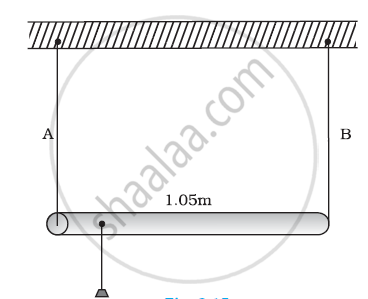
A rod of length 1.05 m having negligible mass is supported at its ends by two wires of steel (wire A) and aluminium (wire B) of equal lengths as shown in Figure. The cross-sectional areas of wires A and B are 1.0 mm2 and 2.0 mm2, respectively. At what point along the rod should a mass m be suspended in order to produce (a) equal stresses and (b) equal strains in both steel and aluminium wires.
Advertisements
उत्तर १
a) 0.7 m from the steel-wire end
Let a small mass m be suspended to the rod at a distance y from the end where wire A is attached.
Stress in wire = `"Force"/"Area"= F/a`
If the two wires have equal stresses, then:
`F_1/a_1 = F_2/a_2`
Where
F1 = Force exerted on the steel wire
F2 = Force exerted on the aluminum wire
`F_1/F_2 = a_1/a_2 = 1/2` ....(i)
The situation is shown in the following figure.
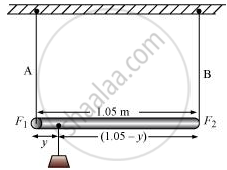
Taking torque about the point of suspension, we have:
`F_1y =F_2(1.05 - y)`
`F_1/F_2 = (1.05 - y)/y` ...(ii)
Using equations (i) and (ii), we can write:
`(1.05 -y)/y = 1/5`
2(1.05 - y) = y
2.1 - 2y = y
3y = 2.1
`:. y = 0.7 m`
In order to produce an equal stress in the two wires, the mass should be suspended at a distance of 0.7 m from the end where wire A is attached.
b) 0.432 m from the steel-wire end
Cross-sectional area of wire A, a1 = 1.0 mm2 = 1.0 × 10⁻⁶ m2
Cross-sectional area of wire B, a2 = 2.0 mm2 = 2.0 × 10⁻⁶ m2
Young’s modulus for steel, Y1 = 2 × 10¹¹ Nm–2
Young’s modulus for aluminium, Y2 = 7.0 ×10¹⁰ Nm–2
`"Young's modulus" = "Stress"/"Strain"`
Strain = `"Stress"/"Young's modulus" = a/Y`
`(F_1/a_1)/Y_1 = (F_2/a_2)/Y_2`
`F_1/F_2 = a_1/a_2 Y_1/Y_2 = 1/2 xx (2xx10^11)/(7xx10^10) =10/7` ....(iii)
Taking torque about the point where mass m, is suspended at a distance y1 from the side where wire A attached, we get:
F1y1 = F2 (1.05 – y1)
`F_1/F_2 = (1.05 - y_1)/y_1` ...(iii)
Using equations (iii) and (iv), we get:
`((1.05 - y_1))/y_1 = 10/7`
`7(1.05 - y_1) = 10y_1`
17y_1 = 7.35
`:.y_1 = 0.432`
In order to produce an equal strain in the two wires, the mass should be suspended at a distance of 0.432 m from the end where wire A is attached
उत्तर २
For steel wire A, l1=l; Az = 1 mm2; Y1= 2 x 10¹¹ Nm-2
For aluminium wire B, l2 = l; A2 = 2mm2; Y2 = 7 x 10¹⁰ Nm-2
a) Let mass m be suspended from the rod at distance x from the end where wire A is connected. Let F1 and F2be the tensions in two wires and there is equal stress in two wires, then
`F_1/A_1 = F_2/A_2 =>F_1/F_2 =A_1/A_2 = 1/2` ... (i)
Taking moment of forces about the point of suspension of mass from the rod, we have
`F_1x = F_2(1.05 - x) or (1.05 - x)/x = F_1/F_2 = 1/2`
or 2.10 - 2x = x => x = 0.70 m = 70 cm
(b) Let mass m be suspended from the rod at distance x from the end where wire A is connected. Let F1 and F2be the tension in the wires and there is equal strain in the two wires i.e.,
`F_1/(A_1Y_1) = F_2/(A_2Y_2) => F_1/F_2 = (A_1Y_1)/(A_2Y_2) = 1/2 xx (2xx10^11)/(7xx10^10) = 10/7`
As the rod is stationary, so `F_1x = F_2(1.05 - x)` or
`(1.05 - x)/x = F_1/F_2 = 10/7`
=>10x =7.35 - 7x or x= 0.4324 m = 43.2 cm
APPEARS IN
संबंधित प्रश्न
A steel cable with a radius of 1.5 cm supports a chairlift at a ski area. If the maximum stress is not to exceed 108 N m–2, what is the maximum load the cable can support?
A rigid bar of mass 15 kg is supported symmetrically by three wires each 2.0 m long. Those at each end are of copper and the middle one is of iron. Determine the ratio of their diameters if each is to have the same tension.
Determine the volume contraction of a solid copper cube, 10 cm on an edge, when subjected to a hydraulic pressure of 7.0 ×10⁶ Pa.
When a block a mass M is suspended by a long wire of length L, the elastic potential potential energy stored in the wire is `1/2` × stress × strain × volume. Show that it is equal to `1/2` Mgl, where l is the extension. The loss in gravitational potential energy of the mass earth system is Mgl. Where does the remaining `1/2` Mgl energy go ?
When some wax is rubbed on a cloth, it becomes waterproof. Explain.
A wire can sustain the weight of 20 kg before breaking. If the wire is cut into two equal parts, each part can sustain a weight of
When a metal wire is stretched by a load, the fractional change in its volume ∆V/V is proportional to
Answer in one sentence.
Define strain.
A charged particle is moving in a uniform magnetic field in a circular path of radius R. When the energy of the particle becomes three times the original, the new radius will be ______.
A spiral spring is stretched by a weight. The strain will be:
Modulus of rigidity of ideal liquids is ______.
The maximum load a wire can withstand without breaking, when its length is reduced to half of its original length, will ______.
A spring is stretched by applying a load to its free end. The strain produced in the spring is ______.
A rectangular frame is to be suspended symmetrically by two strings of equal length on two supports (Figure). It can be done in one of the following three ways;
| (a) |  |
| (b) |  |
| (c) |  |
The tension in the strings will be ______.
Consider two cylindrical rods of identical dimensions, one of rubber and the other of steel. Both the rods are fixed rigidly at one end to the roof. A mass M is attached to each of the free ends at the centre of the rods.
A body of mass m = 10 kg is attached to one end of a wire of length 0.3 m. The maximum angular speed (in rad s-1) with which it can be rotated about its other end in the space station is (Breaking stress of wire = 4.8 × 10⁷ Nm-2 and the area of cross-section of the wire = 10-2 cm2) is ______.
What is the physical quantity defined as the internal restoring force per unit area of a body?
The SI unit of stress is ______.
