Advertisements
Advertisements
प्रश्न
A rod of length l and negligible mass is suspended at its two ends by two wires of steel (wire A) and aluminium (wire B) of equal lengths (Figure). The cross-sectional areas of wires A and B are 1.0 mm2 and 2.0 mm2, respectively.
(YAl = 70 × 109 Nm−2 and Ysteel = 200 × 109 Nm–2)

- Mass m should be suspended close to wire A to have equal stresses in both the wires.
- Mass m should be suspended close to B to have equal stresses in both the wires.
- Mass m should be suspended at the middle of the wires to have equal stresses in both the wires.
- Mass m should be suspended close to wire A to have equal strain in both wires.
Advertisements
उत्तर
b and d
Explanation:
Let the mass is placed at x from the end B.
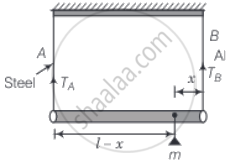
Let TA and TB be the tensions in wire A and wire B respectively.
For the rotational equilibrium of the system,
∑τ = 0 ......(Total torque = 0)
⇒ `T_Bx = T_A (l - x)` = 0
⇒ `T_B/T_A = (l - x)/x` ......(i)
Stress in wire `A = S_A = T_A/a_A`
Stress in wire `B = S_B = T_B/a_B`
Where aA and aB are cross-sectional areas of wire A and B respectively.
By question aB = 2aA
Now, for equal stress SA = SB
⇒ `T_A/a_A = T_B/a_B`
⇒ `T_B/T_A = a_B/a_A` = 2
⇒ `(l - x)/x` = 2
⇒ `l/x - 1` = 2
⇒ `x = l/3`
⇒ `l - x = l - l/3 = (2l)/3`
Hence, mass m should be placed closer to B.
For equal train, (strain)A = (strain)B
⇒ `(Y_A)/S_A = Y_B/S_B` ......(Where YA and YB are Young moduli)
⇒ `Y_(steel)/(T_A/a_A) = Y_(Al)/(T_B/a_B)`
⇒ `Y_(steel)/Y_(Al) = T_A/T_B xx a_B/a_A = (x/(l - x))((2a_A)/a_A)`
⇒ `(200 xx 10^9)/(70 xx 10^9) = (2x)/(l - x)`
⇒ `20/7 = (2x)/(l - x)`
⇒ `10/7 = x/(l - x)`
⇒ `10l - 10x = 7x`
⇒ `17x = 10l`
⇒ `x = (10l)/17`
`l - x = l - (10l)/17 = (7l)/17`
Hence, mass m should be placed closer to wire A.
APPEARS IN
संबंधित प्रश्न
Determine the volume contraction of a solid copper cube, 10 cm on an edge, when subjected to a hydraulic pressure of 7.0 ×10⁶ Pa.
The ratio stress/strain remain constant for small deformation of a metal wire. When the deformation is made larger, will this ratio increase or decrease?
When the skeleton of an elephant and the skeleton of a mouse are prepared in the same size, the bones of the elephant are shown thicker than those of the mouse. Explain why the bones of an elephant are thicker than proportionate. The bones are expected to withstand the stress due to the weight of the animal.
The yield point of a typical solid is about 1%. Suppose you are lying horizontally and two persons are pulling your hands and two persons are pulling your legs along your own length. How much will be the increase in your length if the strain is 1% ? Do you think your yield point is 1% or much less than that?
The breaking stress of a wire depends on
When a metal wire is stretched by a load, the fractional change in its volume ∆V/V is proportional to
Answer in one sentence.
Define strain.
Answer in one sentence.
How should be a force applied on a body to produce shearing stress?
A spiral spring is stretched by a weight. The strain will be:
Modulus of rigidity of ideal liquids is ______.
The maximum load a wire can withstand without breaking, when its length is reduced to half of its original length, will ______.
A spring is stretched by applying a load to its free end. The strain produced in the spring is ______.
A wire is suspended from the ceiling and stretched under the action of a weight F suspended from its other end. The force exerted by the ceiling on it is equal and opposite to the weight.
- Tensile stress at any cross section A of the wire is F/A.
- Tensile stress at any cross section is zero.
- Tensile stress at any cross section A of the wire is 2F/A.
- Tension at any cross section A of the wire is F.
Is stress a vector quantity?
Consider a long steel bar under a tensile stress due to forces F acting at the edges along the length of the bar (Figure). Consider a plane making an angle θ with the length. What are the tensile and shearing stresses on this plane

- For what angle is the tensile stress a maximum?
- For what angle is the shearing stress a maximum?
A steel wire having a radius of 2.0 mm, carrying a load of 4 kg, is hanging from a ceiling. Given that g = 3.1πms-2, what will be the tensile stress that would be developed in the wire?
The stress-strain graph of a material is shown in the figure. The region in which the material is elastic is ______.

What are the dimensions of stress?
