Advertisements
Advertisements
प्रश्न
Two strips of metal are riveted together at their ends by four rivets, each of diameter 6.0 mm. What is the maximum tension that can be exerted by the riveted strip if the shearing stress on the rivet is not to exceed 6.9 × 10⁷ Pa? Assume that each rivet is to carry one-quarter of the load.
Advertisements
उत्तर १
Diameter of the metal strip, d = 6.0 mm = 6.0 × 10⁻³ m
Radius, `r = d/2 = 3.0 xx 10^(-3)m`
Maximum shearing stress = 6.9 × 10⁷ Pa
`"Maximum stress" = "Maximum load or force"/"Area"`
Maximum force = Maximum stress × Area
= 6.9 × 10⁷ × π × (r) 2
= 6.9 × 10⁷ × π × (3 ×10⁻³)2
= 1949.94 N
Each rivet carries one quarter of the load.
∴ Maximum tension on each rivet = 4 × 1949.94 = 7799.76 N
उत्तर २
Diameter = 6mm; Radius, r = 3 x 10⁻³ m;
Maximum stress = 6.9 x 10⁷ Pa
Maximum load on a rivet
= Maximum stress x cross-sectional area
= 6.9 x 107 x 22/7 (3 x 10⁻³)2 N = 1952 N
Maximum tension = 4 x 1951.7 N = 7.8 x 10³ N.
APPEARS IN
संबंधित प्रश्न
A steel cable with a radius of 1.5 cm supports a chairlift at a ski area. If the maximum stress is not to exceed 108 N m–2, what is the maximum load the cable can support?
A rigid bar of mass 15 kg is supported symmetrically by three wires each 2.0 m long. Those at each end are of copper and the middle one is of iron. Determine the ratio of their diameters if each is to have the same tension.
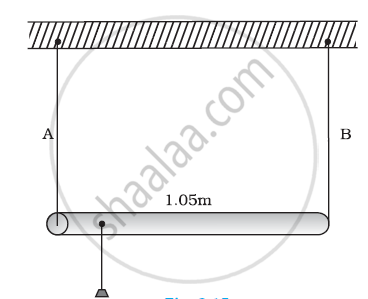
A rod of length 1.05 m having negligible mass is supported at its ends by two wires of steel (wire A) and aluminium (wire B) of equal lengths as shown in Figure. The cross-sectional areas of wires A and B are 1.0 mm2 and 2.0 mm2, respectively. At what point along the rod should a mass m be suspended in order to produce (a) equal stresses and (b) equal strains in both steel and aluminium wires.
The yield point of a typical solid is about 1%. Suppose you are lying horizontally and two persons are pulling your hands and two persons are pulling your legs along your own length. How much will be the increase in your length if the strain is 1% ? Do you think your yield point is 1% or much less than that?
A steel blade placed gently on the surface of water floats on it. If the same blade is kept well inside the water, it sinks. Explain.
When some wax is rubbed on a cloth, it becomes waterproof. Explain.
A heave uniform rod is hanging vertically form a fixed support. It is stretched by its won weight. The diameter of the rod is
Answer in one sentence.
Define strain.
Answer in one sentence.
How should be a force applied on a body to produce shearing stress?
A spiral spring is stretched by a weight. The strain will be:
A rod has a radius of 100 mm and a length of 10 cm. A 100 N force compress along its length. Calculate the longitudinal stress developed in the rod.
Modulus of rigidity of ideal liquids is ______.
Modulus of rigidity of ideal liquids is ______.
A rod of length l and negligible mass is suspended at its two ends by two wires of steel (wire A) and aluminium (wire B) of equal lengths (Figure). The cross-sectional areas of wires A and B are 1.0 mm2 and 2.0 mm2, respectively.
(YAl = 70 × 109 Nm−2 and Ysteel = 200 × 109 Nm–2)

- Mass m should be suspended close to wire A to have equal stresses in both the wires.
- Mass m should be suspended close to B to have equal stresses in both the wires.
- Mass m should be suspended at the middle of the wires to have equal stresses in both the wires.
- Mass m should be suspended close to wire A to have equal strain in both wires.
The area of the cross-section of the rope used to lift a load by a crane is 2.5 × 10⁻⁴m2. The maximum lifting capacity of the crane is 10 metric tons. To increase the lifting capacity of the crane to 25 metric tons, the required area of cross-section of the rope should be ______.
(take g = 10 ms-2)
The stress-strain graph of a material is shown in the figure. The region in which the material is elastic is ______.

What is the physical quantity defined as the internal restoring force per unit area of a body?
Strain is defined as the ratio of ______.
What are the dimensions of stress?
