Advertisements
Advertisements
प्रश्न
Construct ∆XYZ such that l(XY) = 3.7 cm, l(YZ) = 7.7 cm, l(XZ) = 6.3 cm.
Advertisements
उत्तर
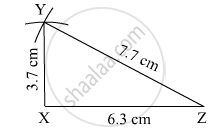
Steps of construction:
- Draw seg XZ of length 6.3 cm.
- Draw an arc of 3.7 cm from the vertex X.
- Draw another arc of 7.7 cm from the vertex Z, cutting the previously drawn arc at Y.
Therefore, △XYZ is the required triangle.
संबंधित प्रश्न
Choose the lengths of the sides yourself and draw one equilateral, one isosceles and one scalene triangle.
Draw triangle with the measures given below.
In ∆MAT, l(MA) = 5.2 cm, m∠A = 80°, l(AT) = 6 cm
Construct a triangle of the measures given below.
In ∆MNP, l(NP) = 5.2 cm, m∠N = 70°, m ∠P = 40°
Students should take examples of their own and practise the construction of triangles.
In ∆LMN, l(LM) = 6.2 cm, m∠LMN = 60°, l(MN) = 4 cm. Construct ∆LMN.
Construct a triangle using the given data: PQ = 6.2cm, ∠P = 105° and ∠ = 45°
Construct an isosceles triangle in which: AB = AC, BC = 6 cm and ∠B = 75°
Construct an isosceles triangle in which: PQ = QR, PR = 4.5 cm and ∠R = 60°
Construct a triangle using the given data: Perimeter of triangle is 6.4 cm, and the base angles are 60° and 45°
Construct a triangle PQR with PQ = 5.4 cm, QR = 4.6 cm and ∠Q = 60°. Draw the perpendicular PS at QR, measure the lengths of SP and SQ,
