Advertisements
Advertisements
प्रश्न
Students should take examples of their own and practise the construction of triangles.
Advertisements
उत्तर
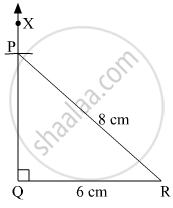
In ∆PQR, l(PR) = 8 cm, m ∠PQR = 90° , l(QR) = 6 cm.
Steps of construction:
- Draw a line QR = 6 cm.
- With Q as centre, draw ∠XQR = 90º.
- With R as centre and 8 cm as radius, cut an arc on XQ and name it as point P.
- Join PR.
∆PQR is thus formed.
संबंधित प्रश्न
In ∆ STU, l(ST) = 7 cm, l(TU) = 4 cm, l(SU) = 5 cm
Draw triangle with the measures given below.
In ∆PRS, l(RS) = 5.5 cm, l(RP) = 4.2 cm, m ∠R = 90°
Construct a triangle of the measures given below.
Construct ∆PQR such that m∠P = 80°, m∠Q = 70°, l(QR) = 5.7 cm.
Construct ∆EFG from the given measures. l(FG) = 5 cm, m∠EFG = 90°, l(EG) = 7 cm.
Construct a triangle using the given data: PQ = 4.8cm, QR = 6.3cm and PR = 5.5cm
Construct a triangle using the given data: DE = 6.5cm, EF = 5.8cm and DF = 4.2cm
Construct a right-angled triangle in which: Side AB = 4.5 cm and hypotenuse AC = 7 cm
Construct an equilateral triangle using the given data: Altitude PM = 3.6 cm
Construct a triangle using the given data: PQ - PR = 1.5 cm, QR = 6.0 and ∠Q = 45°
