Advertisements
Advertisements
प्रश्न
Students should take examples of their own and practise the construction of triangles.
Advertisements
उत्तर
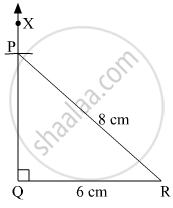
In ∆PQR, l(PR) = 8 cm, m ∠PQR = 90° , l(QR) = 6 cm.
Steps of construction:
- Draw a line QR = 6 cm.
- With Q as centre, draw ∠XQR = 90º.
- With R as centre and 8 cm as radius, cut an arc on XQ and name it as point P.
- Join PR.
∆PQR is thus formed.
संबंधित प्रश्न
In ∆ PQR, l(PQ) = 6 cm, l(QR) = 3.8 cm, l(PR) = 4.5 cm
Draw triangle with the measures given below.
In ∆FUN, l(FU) = 5 cm, l(UN) = 4.6 cm, m∠U = 110°
Construct a triangle of the measures given below.
In ∆MNP, l(NP) = 5.2 cm, m∠N = 70°, m ∠P = 40°
Construct a triangle using the given data: BC = 6cm, AC = 5.0cm and ∠C = 60°
Construct a triangle using the given data: XY = 5.2cm, XZ = 6.5cm and ∠X = 75°
Construct a triangle using the given data: DE = 5cm, ∠D = 75° and ∠E = 60°
Construct an isosceles triangle in which: AB = AC, BC = 6 cm and ∠B = 75°
Construct a triangle using the given data: Perimeter of triangle is 9 cm, and the base angles are 60° and 45°
Construct a ΔXYZ with YZ = 7.5 cm, ∠Y = 60° and ∠Z = 45°. Draw the bisectors of ∠Y and ∠Z. If these bisectors meet at O, measure angle YOZ.
Construct a ΔRST with side ST = 5.4 cm, RST = 60° and the perpendicular from R on ST = 3.0 cm.
