Advertisements
Advertisements
प्रश्न
Construct ∆XYZ such that l(XY) = 3.7 cm, l(YZ) = 7.7 cm, l(XZ) = 6.3 cm.
Advertisements
उत्तर
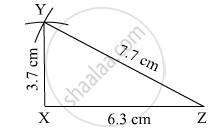
Steps of construction:
- Draw seg XZ of length 6.3 cm.
- Draw an arc of 3.7 cm from the vertex X.
- Draw another arc of 7.7 cm from the vertex Z, cutting the previously drawn arc at Y.
Therefore, △XYZ is the required triangle.
संबंधित प्रश्न
Draw triangle with the measures given below.
In ∆ NTS, m ∠T = 40°, l(NT) = l(TS) = 5 cm
Draw triangle with the measures given below.
In ∆FUN, l(FU) = 5 cm, l(UN) = 4.6 cm, m∠U = 110°
Draw triangle with the measures given below.
In ∆PRS, l(RS) = 5.5 cm, l(RP) = 4.2 cm, m ∠R = 90°
Construct a triangle of the measures given below.
In ∆SAT, l(AT) = 6.4 cm, m ∠A = 45°, m ∠T = 105°
Construct a triangle of the measures given below.
In ∆EFG, l(EG) = 6 cm, m∠F = 65°, m∠G = 45°
Construct a triangle of the measures given below.
In ∆ABC, l(AC) = 7.5 cm, m ∠ABC = 90°, l(BC) = 5.5 cm.
Construct ∆ABC such that m∠A = 55°, m∠B = 60°, and l(AB) = 5.9 cm.
Construct a triangle using the given data: DE = 6.5cm, EF = 5.8cm and DF = 4.2cm
Construct a triangle using the given data: BC = 6.0cm, ∠B = 60° and ∠C = 45°
Construct a right-angled triangle in which: QP = QR and hypotenuse PR = 7 cm
