Advertisements
Advertisements
प्रश्न
Construct a rhombus ABCD whose diagonals AC and BD are 8 cm and 6 cm respectively. Find by construction a point P equidistant from AB and AD and also from C and D.
Advertisements
उत्तर

Steps of Construction:
(i) Draw BC = 6 cm.
(ii) Draw AD = 8 on perpendicular to BC.
(iii) With B as centre draw arcs on AD.
(iv) With C as centre draw arcs on AD. ABCD is the required rhombus.
(v) Draw perpendicular bisectors of AB, and CD, which meet at 0.
(vi) Since AD and BC are diagonals of rhombus and meet at 0.
AO = OD
O is the point equidistant from AB, AD and C, D.
APPEARS IN
संबंधित प्रश्न
Construct a ti.PQR, in which PQ=S. 5 cm, QR=3. 2 cm and PR=4.8 cm. Draw the locus of a point which moves so that it is always 2.5 cm from Q.
Construct a Δ XYZ in which XY= 4 cm, YZ = 5 cm and ∠ Y = 1200. Locate a point T such that ∠ YXT is a right angle and Tis equidistant from Y and Z. Measure TZ.
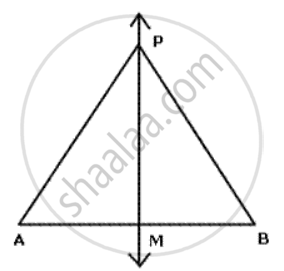
A and B are fixed points while Pis a moving point, moving in a way that it is always equidistant from A and B. What is the locus of the path traced out by the pcint P?
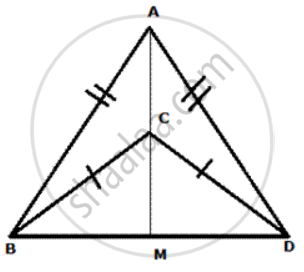
In given figure 1 ABCD is an arrowhead. AB = AD and BC = CD. Prove th at AC produced bisects BD at right angles at the point M
Draw and describe the lorus in the following cases:
The locus of points at a distance of 4 cm from a fixed line.
Draw and describe the lorus in the following cases:
The Iocus of the mid-points of all parallel chords of a circle.
Draw and describe the locus in the following case:
The locus of a point in rhombus ABCD which is equidistant from AB and AD.
Draw and describe the locus in the following case:
The locus of a point in the rhombus ABCD which is equidistant from the point A and C.
Construct a triangle BPC given BC = 5 cm, BP = 4 cm and .
i) complete the rectangle ABCD such that:
a) P is equidistant from AB and BCV
b) P is equidistant from C and D.
ii) Measure and record the length of AB.
How will you find a point equidistant from three given points A, B, C which are not in the same straight line?
