Advertisements
Advertisements
प्रश्न
Construct an equilateral ∆ABC with side 5 cm. ∆ABC ~ ∆LMN, ratio the corresponding sides of triangle is 6 : 7, then construct ΔLMN and ΔABC.
Advertisements
उत्तर
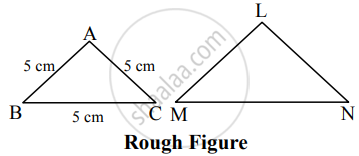
Analysis:
∆ABC ∼ ∆LMN
∴ `(AB)/(LM) = (BC)/(MN) = (AC)/(LN)` ...[Corresponding sides of similar triangles]
∴ `5/(LM) = 5/(MN) = 5/(LN) = 6/7` ...[Given]
∴ `5/(LM) = 6/7`
∴ `LM = (5 xx 7)/6`
∴ LM = 5.8 cm (approx)
∴ LM = MN = LN = 5.8 cm (approx) ...[Equilateral triangle]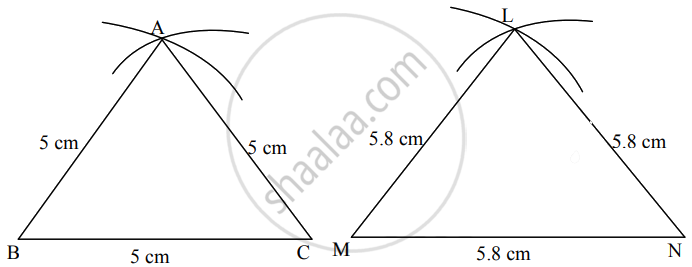
Steps of Construction:
| ∆ABC | ∆LMN | |
| i. | Draw seg BC of 5 cm | Draw seg MN of 5.8 cm |
| ii. | Draw two arcs at 5 cm from point B and point C respectively. | Draw two arcs at 5.8 cm from point M and point N respectively. |
| iii. | Name the point of intersection of two arcs as A. | Name the point of intersection of two arcs as L. |
| iv. | Join seg AB and seg AC. | Join seg LM and seg LN. |
संबंधित प्रश्न
Write down the equation of a line whose slope is 3/2 and which passes through point P, where P divides the line segment AB joining A(-2, 6) and B(3, -4) in the ratio 2 : 3.
Construct a triangle of sides 4 cm, 5cm and 6cm and then a triangle similar to it whose sides are `2/3` of the corresponding sides of the first triangle. Give the justification of the construction.
Construct an isosceles triangle whose base is 8 cm and altitude 4 cm and then another triangle whose side are `1 1/2` times the corresponding sides of the isosceles triangle.
Give the justification of the construction
Draw a right triangle in which the sides (other than the hypotenuse) are of lengths 4 cm and 3 cm. Now construct another triangle whose sides are `3/5` times the corresponding sides of the given triangle.
Divide a line segment of length 9 cm internally in the ratio 4 : 3. Also, give justification of the construction.
∆ABC ~ ∆LBN. In ∆ABC, AB = 5.1 cm, ∠B = 40°, BC = 4.8 cm, \[\frac{AC}{LN} = \frac{4}{7}\]. Construct ∆ABC and ∆LBN.
______ number of tangents can be drawn to a circle from the point on the circle.
∆ABC ~ ∆PBQ. In ∆ABC, AB = 3 cm, ∠B = 90°, BC = 4 cm. Ratio of the corresponding sides of two triangles is 7 : 4. Then construct ∆ABC and ∆PBQ.
ΔRHP ~ ΔNED, In ΔNED, NE = 7 cm, ∠D = 30°, ∠N = 20° and `"HP"/"ED" = 4/5`. Then construct ΔRHP and ΔNED
To divide a line segment AB in the ratio p : q (p, q are positive integers), draw a ray AX so that ∠BAX is an acute angle and then mark points on ray AX at equal distances such that the minimum number of these points is ______.
To divide a line segment AB in the ratio 4 : 7, a ray AX is drawn first such that ∠BAX is an acute angle and then points A1, A2, A3, .... are located at equal distances on the ray AX and the point B is joined to ______.
To construct a triangle similar to a given ΔABC with its sides `8/5` of the corresponding sides of ΔABC draw a ray BX such that ∠CBX is an acute angle and X is on the opposite side of A with respect to BC. Then minimum number of points to be located at equal distances on ray BX is ______.
A triangle ABC is such that BC = 6cm, AB = 4cm and AC = 5cm. For the triangle similar to this triangle with its sides equal to `3/4`th of the corresponding sides of ΔABC, correct figure is?
Draw the line segment AB = 5cm. From the point A draw a line segment AD = 6cm making an angle of 60° with AB. Draw a perpendicular bisector of AD. Select the correct figure.
To divide a line segment PQ in the ratio 5 : 7, first a ray PX is drawn so that ∠QPX is an acute angle and then at equal distances points are marked on the ray PX such that the minimum number of these points is ______.
When a line segment is divided in the ratio 2 : 3, how many parts is it divided into?
The basic principle used in dividing a line segment is ______.
Draw a line segment of length 7.5 cm and divide it in the ratio 1:3.
Draw a line segment of length 7 cm and divide it in the ratio 5 : 3.
