Advertisements
Advertisements
प्रश्न
Complete the following reaction, balance it and write the name of the products CuO + HCI →_________ + _________
Advertisements
उत्तर
CuO + 2HCl → CuCl2 + H2O
The name of the products are copper(II) chloride (CuCl2) (also known as cupric chloride or copper chloride) and water (H2O).
APPEARS IN
संबंधित प्रश्न
Give an example of a double displacement reaction other than the one given in the following Activity.
•Take about 3 mL of sodium sulphate
solution in a test tube.
• In another test tube, take about 3 mL of
barium chloride solution.
• Mix the two solutions given in the following fig.
• What do you observe?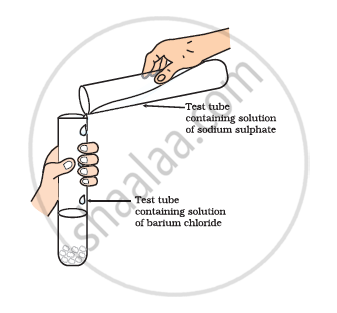
Write the balanced chemical equation for the following and identify the type of reaction.
\[\ce{Potassium bromide (aq) + Barium iodide (aq) -> Potassium iodide (aq) + Barium bromide (s)}\]
What is the difference between displacement and double displacement reactions? Write equations for these reactions.
What do you mean by a precipitation reaction? Explain giving an example.
Give two characteristics of the chemical reaction which occurs on adding potassium iodide solution to lead nitrate solution.
What type of chemical reaction is represented by the following equation?
\[\ce{PQ + RS -> PS + RQ}\]
What type of reaction is represented by the following equation?
\[\ce{CuSO4 + 2NaOH -> Cu(OH)2 + Na2SO4}\]
What happens when silver nitrate solution is added to sodium chloride solution?
Name the type of reaction involved.
- What happens when an aqueous solution of sodium sulphate reacts with an aqueous solution of barium chloride?
- Write the balanced chemical equation for the reaction which takes place.
- State the physical conditions of reactants in which the reaction will not take place.
- Name the type of chemical reaction which occurs.
- Give one example of another reaction which is of the same type as the above reaction.
Consider the reaction:
\[\ce{KBr_{(aq)} + AgNO3_{(aq)} -> KNO3_{(aq)} + AgBr_{(s)}}\]
This is an example of:
A metal X forms a water soluble salt XNO3. When an aqueous solution of XNO3 is added to common salt solution, then a white precipitate of compound Y is formed along with sodium nitrate solution. Metal X is said to be the best conductor of electricity and it does not evolve hydrogen when put in dilute hydrohloric acid.
- What is metal X?
- What is salt XNO3?
- Name the compound Y.
- Write the chemical equation of the reaction which takes place on reacting XNO3 solution and common salt solution giving the physical states of all the reactants and products.
- What type of chemical reaction is illustrated by the above equation?
Fill in the blank
In the type of reaction called ....................................., ions two compounds exchange their positive and negative radicals ions respectively.
Explain the following type of chemical reaction, giving two examples for it:
Double displacement reaction
Study the following chemical reaction and answer the questions given below:
\[\ce{AgNO3_{(aq)} + NaCl_{(aq)} -> \underset{(Precipitate)}{AgCl_{(s)}}↓ + NaNO3_{(aq)}}\]
- Identify and write the type of chemical reaction.
- Write the definition of the above type of chemical reaction.
- Write the names of the reactants and products of the above reaction.
When hydrogen sulphide gas is passed through a blue solution of copper sulphate, a black precipitate of copper sulphide is obtained and the sulphuric acid so formed remains in the solution. The reaction is an example of a:
In a double displacement reaction such as the reaction between sodium sulphate solution and barium chloride solution:
- exchange of atoms takes place
- exchange of ions takes place
- a precipitate is produced
- an insoluble salt is produced
The correct option is:
Identify the type of reaction taking place in the following case and write the balanced chemical equation for the reaction.
Potassium iodide reacts with lead nitrate to produce potassium nitrate and lead iodide.
When a potassium iodide solution is added to a solution of lead (II) nitrate in a test tube, a precipitate is formed.
List two types of reactions in which this reaction can be placed.
Differentiate between displacement reaction and a neutralization reaction.
Which of the following represents a precipitation reaction?
Explain the types of double displacement reactions with examples.
Barium chloride on reacting with ammonium sulphate forms barium sulphate and ammonium chloride. Which of the following correctly represents the type of reaction involved?
(i) Displacement reaction
(ii) Precipitation reaction
(iii) Combination reaction
(iv) Double displacement reaction
Add potassium chromate (K2CrO4) into the solution of barium sulphate (BaSO4).
- What was the colour of the precipitate formed? Also, write the name of the precipitate.
- Write down the balanced equation for this reaction.
- Will you call this reaction a displacement reaction or a double displacement reaction? Why?

Identify the product which represents the solid state in the above reaction.
A chemical reaction in which exchange of ions occurs between the reactants is known as ______.
Write balanced chemical equation for the following word equation.
Lead nitrate + Potassium iodide → Lead iodide + Potassium nitrate
Is this a double displacement reaction? Justify your answer. Name the compound precipitated and write the ions present in it.
Give scientific reason.
While preparing dilute sulphuric acid from concentrated sulphuric acid in the laboratory, the concentrated sulphuric acid is added slowly to water with constant stirring.
Give an example of a double displacement reaction.
