Advertisements
Advertisements
प्रश्न
A very long bar magnet is placed with its north pole coinciding with the centre of a circular loop carrying as electric current i. The magnetic field due to the magnet at a point on the periphery of the wire is B. The radius of the loop is a. The force on the wire is
पर्याय
very nearly 2πaiB perpendicular to the plane of the wire
2πaiB in the plane of the wire
πaiB along the magnet
zero
Advertisements
उत्तर
very nearly `2pi aiB` perpendicular to the plane of the wire
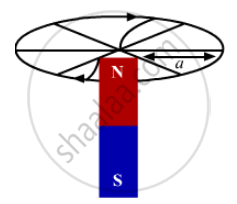
In this case, the north pole of the magnet is coinciding with the centre of the circular loop carrying electric current i. So, the magnetic field lines almost lie on the plane of the ring and the force due to the field lines is perpendicular to the field lines and to the plane of the circular ring.
Let idl be the current element, B be the magnetic field and dF be the force on the current element idl.
Now
`dF = B i dl ⇒ F = ∫_0^(2pia) B i dl`
⇒ `F = 2pi a iB`
Thus, the force acting on the wire is `2pi a iB` and it is perpendicular to the plane of the wire.
APPEARS IN
संबंधित प्रश्न
Write two characteristics of a material used for making permanent magnets ?
Why is the core of an electromagnet made of ferromagnetic materials?
Can we have a single north pole, or a single south pole?
The force on a north pole, `vecF = mvecB` , parallel to the field `vecB` . Does it contradict our earlier knowledge that a magnetic field can exert forces only perpendicular to itself?
Which of the following four graphs may best represent the current-deflection relation in a tangent galvanometer?

A uniform magnetic field of `0.20 xx 10^-3 "T"` exists in the space. Find the change in the magnetic scalar potential as one moves through 50 cm along the field.
The magnetic field at a point, 10 cm away from a magnetic dipole, is found to be `2.0 xx 10^-4 "T"` . Find the magnetic moment of the dipole if the point is (a) in end-on position of the dipole and (b) in broadside-on position of the dipole.
The desirable properties for making permanent magnets are _________________ .
The coercive force for a certain permanent magnet is 4.0 × 10⁴ A m−1. This magnet is placed inside a long solenoid of 40 turns/cm and a current is passed in the solenoid to demagnetise it completely. Find the current.
The magnetic moment of the assumed dipole at the earth's centre is 8.0 × 10²² A m2. Calculate the magnetic field B at the geomagnetic poles of the earth. Radius of the earth is 6400 km.
If the earth's magnetic field has a magnitude 3.4 × 10⁻⁵ T at the magnetic equator of the earth, what would be its value at the earth's geomagnetic poles?
A magnetic needle is free to rotate in a vertical plane which makes an angle of 60° with the magnetic meridian. If the needle stays in a direction making an angle of `tan^-1(2sqrt(3))` with the horizontal, what would be the dip at that place?
A short magnet produces a deflection of 37° in a deflection magnetometer in Tan-A position when placed at a separation of 10 cm from the needle. Find the ratio of the magnetic moment of the magnet to the earth's horizontal magnetic field.
A short magnet oscillates in an oscillation magnetometer with a time period of 0.10 s where the earth's horizontal magnetic field is 24 μT. A downward current of 18 A is established in a vertical wire placed 20 cm east of the magnet. Find the new time period.
A short magnet makes 40 oscillations per minute when used in an oscillation magnetometer at a place where the earth's horizontal magnetic field is 25 μT. Another short magnet of magnetic moment 1.6 A m2 is placed 20 cm east of the oscillating magnet. Find the new frequency of oscillation if the magnet has its north pole (a) towards north and (b) towards south.
Answer in brief.
Explain one application of electromagnet.
Assertion: Electromagnetic are made of soft iron.
Reason: Coercivity of soft iron is small.
A steel wire of length 1 has a magnetic moment m it is then bent into a semicircular arc. The new magnetic moment is
