Advertisements
Advertisements
प्रश्न
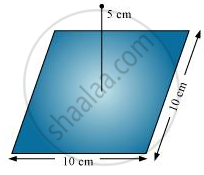
A point charge +10 μC is a distance 5 cm directly above the centre of a square of side 10 cm, as shown in the Figure. What is the magnitude of the electric flux through the square? (Hint: Think of the square as one face of a cube with edge 10 cm.)
Advertisements
उत्तर

Based on the illustration, we can assume that the given square represents one side of a cube with an edge length of 10 cm.
The cube encloses the +10 µC charge because it is located 5 cm above the square's center. According to Gauss's theorem, cube-linked electric flow is
Φ = `q/ε_0`
= `(10 xx 10^-6)/(8.85 xx 10^-12)`
= 1.13 × 10⁶ N m2 C−1
Consequently, the electromotive force acting on the square
Φsq = `"Φ"/6`
= `1.13/6 xx 10^6`
or Φsq = 1.9 × 10⁵ N m2 C−1
संबंधित प्रश्न
Draw a graph of electric field E(r) with distance r from the centre of the shell for 0 ≤ r ≤ ∞.
A charge Q is placed at the centre of a cube. Find the flux of the electric field through the six surfaces of the cube.
State Gauss’s law on electrostatics and drive expression for the electric field due to a long straight thin uniformly charged wire (linear charge density λ) at a point lying at a distance r from the wire.
Gaussian surface cannot pass through discrete charge because ____________.
q1, q2, q3 and q4 are point charges located at points as shown in the figure and S is a spherical gaussian surface of radius R. Which of the following is true according to the Gauss' law?

The Gaussian surface ______.
The surface considered for Gauss’s law is called ______.
Gauss' law helps in ______
The Electric flux through the surface
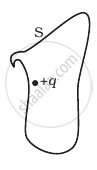 (i) |
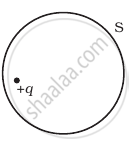 (ii) |
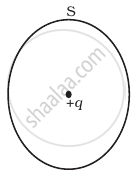 (iii) |
 (iv) |
If `oint_s` E.dS = 0 over a surface, then ______.
- the electric field inside the surface and on it is zero.
- the electric field inside the surface is necessarily uniform.
- the number of flux lines entering the surface must be equal to the number of flux lines leaving it.
- all charges must necessarily be outside the surface.
If there were only one type of charge in the universe, then ______.
- `oint_s` E.dS ≠ 0 on any surface.
- `oint_s` E.dS = 0 if the charge is outside the surface.
- `oint_s` E.dS could not be defined.
- `oint_s` E.dS = `q/ε_0` if charges of magnitude q were inside the surface.
Refer to the arrangement of charges in figure and a Gaussian surface of radius R with Q at the centre. Then

- total flux through the surface of the sphere is `(-Q)/ε_0`.
- field on the surface of the sphere is `(-Q)/(4 piε_0 R^2)`.
- flux through the surface of sphere due to 5Q is zero.
- field on the surface of sphere due to –2Q is same everywhere.
An arbitrary surface encloses a dipole. What is the electric flux through this surface?
In finding the electric field using Gauss law the formula `|vec"E"| = "q"_"enc"/(epsilon_0|"A"|)` is applicable. In the formula ε0 is permittivity of free space, A is the area of Gaussian surface and qenc is charge enclosed by the Gaussian surface. This equation can be used in which of the following situation?
