Advertisements
Advertisements
प्रश्न
A light metal disc on the top of an electromagnet is thrown up as the current is switched on. Why? Give reason.
Advertisements
उत्तर
When the current begins to grow through the electromagnet, the magnetic flux through the disc begins to increase. This sets up eddy current in the disc in the same direction as that of the electromagnetic current. Thus, if the upper surface of electromagnet acquires N-polarity, the lower surface of the disc also acquires N-polarity. As same magnetic poles repel each other, the light metallic disc is thrown up.
APPEARS IN
संबंधित प्रश्न
The device used for producing electric current is called _________.
State three differences between direct current and alternating current.
Fill in the blanks by writing (i) Only soft iron, (ii) Only steel, (iii) Both soft-iron and steel for the material of core and/or magnet.
Transformer______.
Choose the correct option:
A conductor rod of length (l) is moving with velocity (v) in a direction normal to a uniform magnetic field (B). What will be the magnitude of induced emf produced between the ends of the moving conductor?
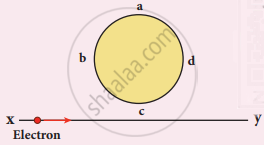
An electron moves on a straight-line path XY as shown in the figure. The coil abcd is adjacent to the path of the electron. What will be the direction of the current, if any, induced in the coil?
The magnetic flux passing through a coil perpendicular to its plane is a function of time and is given by OB = (2t3 + 4t2 + 8t + 8) Wb. If the resistance of the coil is 5 Ω, determine the induced current through the coil at a time t = 3 second.
The instrument that use to defect electric current in the circuit is known as ____________.
Show that for a given positive ion species in a cyclotron, (i) the radius of their circular path inside a dee is directly proportional to their speed, and (ii) the maximum ion energy achievable is directly proportional to the square of the magnetic induction.
Around 1830, who showed that an electric current can be induced in a closed coil exposed to a changing magnetic field?
Which charging technology works on electromagnetic induction?
