Advertisements
Advertisements
प्रश्न
A cell supplies a current of 1.2 A through two 2 Ω resistors connected in parallel. When the resistors are connected in series, it supplies a current of 0.4 A. Calculate:
(i) the internal resistance and (ii) e.m.f. of the cell.
Advertisements
उत्तर
In parallel R = ½ + ½ = 1 ohm
I = 1.2 A
ε = I(R + r)
= 1.2(1 + r)
= 1.2 + 1.2 r
In series R = 2 + 2 = 4 ohm
I = 0.4 A
ε = I(R + r)
= 0.4(4 + r)
= 1.6 + 0.4 r
It means:
1.2 + 1.2 r = 1.6 + 0.4 r
0.8 r = 0.4
r = 0.4 / 0.8 = ½ = 0.5 ohm
(i) Internal resistance r = 0.5 ohm
(ii) ε = I(R + r)
= 1.2(1 + 0.5)
= 1.8 V
संबंधित प्रश्न
Which unit could be used to measure current?
(a) Watt
(b) Coulomb
(c) Volt
(d) Ampere
An electric circuit consisting of a 0.5 m long nichrome wire XY, an ammeter, a voltmeter, four cells of 1.5 V each and a plug key was set up.
(i) Draw a diagram of this electric circuit to study the relation between the potential difference maintained between the points 'X' and 'Y' and the electric current flowing through XY.
Find the effective resistance in the following circuit diagrams (Fig.):
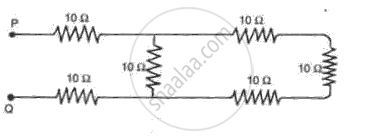
What would be the danger involved in replacing a blown fuse with the one which would carry a large current?
Tick (✓) the correct choice among the following :
There are 500 turns and 2000 turns in the primary and secondary coil of a
transformer respectively. If th e output voltage is 1000 V, how large is the
input voltage?
An electric bulb is rated '100 W, 250 V'. How much current will the bulb draw if connected to a 250 V supply?
One unit of electrical energy consumed is equal to 1000 kilowatt-hour.
Which of the following is the example expression for Alternating Current?
