Advertisements
Advertisements
प्रश्न
A cell supplies a current of 1.2 A through two 2 Ω resistors connected in parallel. When the resistors are connected in series, it supplies a current of 0.4 A. Calculate:
(i) the internal resistance and (ii) e.m.f. of the cell.
Advertisements
उत्तर
In parallel R = ½ + ½ = 1 ohm
I = 1.2 A
ε = I(R + r)
= 1.2(1 + r)
= 1.2 + 1.2 r
In series R = 2 + 2 = 4 ohm
I = 0.4 A
ε = I(R + r)
= 0.4(4 + r)
= 1.6 + 0.4 r
It means:
1.2 + 1.2 r = 1.6 + 0.4 r
0.8 r = 0.4
r = 0.4 / 0.8 = ½ = 0.5 ohm
(i) Internal resistance r = 0.5 ohm
(ii) ε = I(R + r)
= 1.2(1 + 0.5)
= 1.8 V
संबंधित प्रश्न
If the current through a floodlamp is 5 A, what charge passed in 10 seconds?
(a) 0.5 C
(b) 2 C
(c) 5 C
(d) 50 C
Give three reasons why different electrical appliances in a domestic circuit are connected in parallel.
For a heater rated at 4 kW and 220 V, calculate:
(a) the current,
(b) the resistance of the heater,
(c) the energy consumed in 2 hours, and
(d) the cost if 1 kWh is priced at Rs 4.60.
Which effect of current is utilised in an electric light bulb?
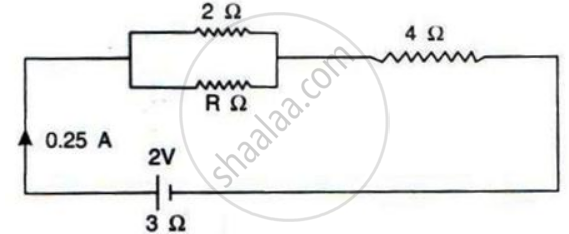
The following circuit diagram shows three resistors 2 Ω, 4 Ω and R Ω connected to a battery of e.m.f 2V and internal resistance 3 Ω. If the main current of 0.25 A flows through the circuit, find:
- the p.d. across the 4 Ω resistors,
- the p.d. across the internal resistance of the cell,
- the p.d. across the R Ω or 2 Ω resistors, and
- the value of R.
Tick(✓) the correct choice in the following:
Which of the following quantities has the same value for all electrical
appliances connected to the ring main circuit in a house?
Calculate the current in a wire if a charge of 1500 coulomb flows through it in 5 minutes.
A continuous and closed path of an electric current is called:
