Advertisements
Advertisements
प्रश्न
A cell of e.m.f. 2 V and internal resistance 1.2 Ω is connected to an ammeter of resistance 0.8 Ω and two resistors of 4.5 Ω and 9 Ω as shown in following figure.
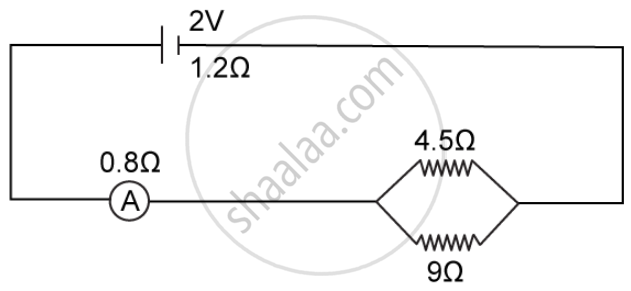
Find:
- The reading of the ammeter,
- The potential difference across the terminals of the cells, and
- The potential difference across the 4.5 Ω resistor.
Advertisements
उत्तर
The total resistance of the circuit is
`"R"_"eq" = "R"_"cell" + "R"_"ammeter" + "R"_1 || "R"_2`
`therefore "R"_"eq" = 1.2 + 0.8 + ("R"_1"R"_2)/("R"_1 + "R"_2)`
`therefore "R"_"eq" = 2 + (4.5 xx 9)/(4.5 + 9)`
= `2 + 40.5/13.5`
`therefore "R"_"eq" = 5 Omega`
(a) Therefore, the current through the ammeter is
I = `"E"_"cell"/"R"_"eq" = 2/5 = 0.4 "A"`
(b) The potential difference across the ends of the cells is
`"V"_"cell" = "E"_"cell" - "IR"_"cell"`
`therefore "V"_"cell" = 2 - 0.4 xx 1.2`
`therefore "V"_"cell" = 2 - 0.48 = 1.52 "V"`
(c) The potential difference across the 4.5 Ω resistor is
`"V"_4.5 = "V"_"cell" - "V"_"ammeter"`
`therefore "V"_4.5 = 1.52 - 0.4 xx 0.8`
`therefore "V"_4.5 = 1.52 - 0.32`
`therefore "V"_4.5 = 1.2 "V"`
APPEARS IN
संबंधित प्रश्न
Name two factors on which the internal resistance of a cell depends and state how does it depend on the factors stated by you.
A cell is used to send current to an external circuit.
- How does the voltage across its terminals compare with its e.m.f.?
- Under what condition is the e.m.f. of a cell equal to its terminal voltage?
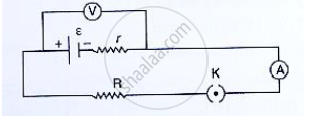
The diagram below in Fig. 8.40 shows a cell of e.m.f. ε = 2 volt and internal resistance r = 1 ohm to an external resistance R = 4 ohm. The ammeter A measures the current in the circuit and the
voltmeter V measures the terminal voltage across the cell. What will be the readings of the ammeter and voltmeter when (i) the key K is open, (ii) the key K is closed.
A cell of e.m.f. 1.8V and internal resistance 2Ω is connected in series with an ammeter of resistance 0.7Ω and a resistor of 4.5Ω as shown in Fig.
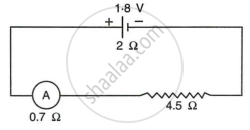
- What would be the reading of the ammeter?
- What is the potential difference across the terminals of the cell?
A cell of emf. 1.5 V and internal resistance 10 ohms is connected to a resistor of 5 ohms, with an ammeter in series see fig.. What is the reading of the ammeter?
Four cells, each of e.m.f. 1.5 V and internal resistance 2.0 ohms are connected in parallel. The battery of cells is connected to an external resistance of 2.5 ohms. Calculate:
(i) The total resistance of the circuit.
(ii) The current flowing in the external circuit.
(iii) The drop in potential across-the terminals of the cells.
Define the e.m.f. (E) of a cell and the potential difference (V) of a resistor R in terms of the work done in moving a unit charge. State the relation between these two works and the work done in moving a unit charge through a cell connected across the resistor. Take the internal resistance of the cell as ‘r’. Hence obtain an expression for the current i in the circuit.
A battery of 4 cell, each of e.m.f. 1.5 volt and internal resistance 0.5 Ω is connected to three resistances as shown in the figure. Calculate:
(i) The total resistance of the circuit.
(ii) The current through the cell.
(iii) The current through each resistance.
(iv) The p.d. across each resistance.
A cell supplies a current of 0.6 A through a 2Ω coil and a current of 0.3 A through on 8Ω coil. Calculate the e.m.f and internal resistance of the cell.
A battery of e.m.f. 6.0 V supplies current through a circuit in which the resistance can be changed. A high resistance voltmeter is connected across the battery. When the current is 3 A, the voltmeter reads 5.4 V. Find the internal resistance of the battery.
