Advertisements
Advertisements
प्रश्न
When a resistance of 3Ω is connected across a cell, the current flowing is 0.5 A. On changing the resistance to 7Ω, the current becomes 0.25A. Calculate the e.m.f. and the internal resistance of the cell.
Advertisements
उत्तर
I = `"E"/("R + r")`
∴ `0.5 = "E"/(3 + "r")` ....(as I = 0.5 A when R = 3Ω)
∴ E = (3 + r) × 0.5 ....(i)
also 0.25 = `"E"/(7 + "r")` ...(as I = 0.25 A when R = 7 W)
∴ E = (7 + r) × 0.25 ....(ii)
Comparing equation (i) and (ii)
E = (3 + r) × 0.5
= (7 + r) × 0.25
∴ 1.5 + 0.5r = 1.75 + 0.25r
∴ 0.25 r = 0.25
Internal resistance = r = 1 Ω
Now E = I (R + r)
∴ E = 0.5(3 + 1) (as I = 0.5 A when R = 3 Ω, r = 1 Ω)
∴ E = 0.5 + 1.5 = 2 V
E.m.f. of cell E = 2 volt = 2 V.
संबंधित प्रश्न
A cell of e.m.f ε and internal resistance r is used to send current to an external resistance R. Write expressions for
- the total resistance of circuit.
- the current drawn from the cell.
- the p.d. across the cell.
- voltage drop inside the cell.
Explain why the p.d across the terminals of a cell is more in an open circuit and reduced in a closed circuit.
A battery of e.m.f 3.0 V supplies current through a circuit in which the resistance can be changed.
A high resistance voltmeter is connected across the battery. When the current is 1.5 A, the voltmeter reads 2.7 V. Find the internal resistance of the battery.
A battery of e.m.f. 15 V and internal resistance 3 ohm is connected to two resistors of resistances 3 ohm and 6 ohm is series Find:
(a) the current through the battery
(b) the p.d. between the terminals of the battery.
A cell of e.m.f. ε and internal resistance 𝔯 sends current 1.0 A when it is connected to an external resistance 1.9 Ω. But it sends current 0.5 A when it is connected to an external resistance 3.9 Ω. Calculate the values of ε and 𝔯.
A cell of e.m.f. 2 V and internal resistance 1.2 Ω is connected to an ammeter of resistance 0.8 Ω and two resistors of 4.5 Ω and 9 Ω as shown in following figure.
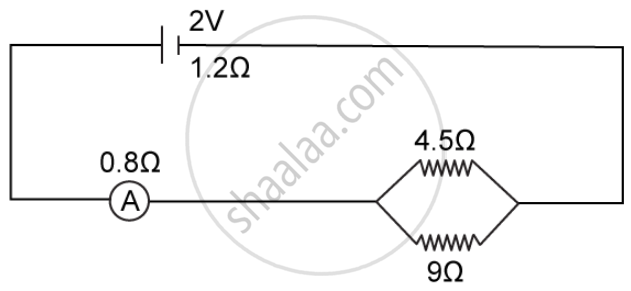
Find:
- The reading of the ammeter,
- The potential difference across the terminals of the cells, and
- The potential difference across the 4.5 Ω resistor.
A cell of emf. 1.5 V and internal resistance 10 ohms is connected to a resistor of 5 ohms, with an ammeter in series see fig.. What is the reading of the ammeter?
Explain the meaning of the term internal resistance of a cell.
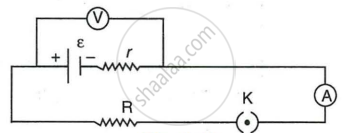
The diagram in Figure shows a cell of e.m.f. ε = 4 volt and internal resistance r = 2 ohm connected to an external resistance R = 8 ohm. The ammeter A measures the current in the circuit and the voltmeter V measures the terminal voltage across the cell. What will be the readings of the ammeter and voltmeter when
- the key K is open, and
- the key K is closed
A battery of e.m.f. 6.0 V supplies current through a circuit in which the resistance can be changed. A high resistance voltmeter is connected across the battery. When the current is 3 A, the voltmeter reads 5.4 V. Find the internal resistance of the battery.
