Advertisements
Advertisements
प्रश्न
A battery of 4 cell, each of e.m.f. 1.5 volt and internal resistance 0.5 Ω is connected to three resistances as shown in the figure. Calculate:
(i) The total resistance of the circuit.
(ii) The current through the cell.
(iii) The current through each resistance.
(iv) The p.d. across each resistance.
Advertisements
उत्तर
Let total e.m.f. of 4 cells = nE (n = number of cells)
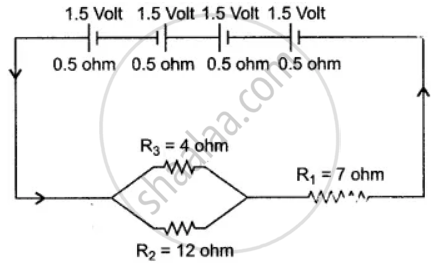
E = 4 × 1.5
E = 6 volts ....(i)
Total internal resistance = nr (n = 4, r = 0.5 Ω)
Total internal resistance = 4 × 0.5 (in series)
= 2 Ω ....(ii)
Let total external resistance = X Ω
`1/"R" = 1/"R"_1 + 1/"R"_2` (R1 and R2 are in parallel)
`1/"R" = 1/4 + 1/12 = (3 + 1)/12 = 4/12`
R = `12/4 = 3 Ω`
Total external resistance = X = (R + R3)Ω (in series)
X = 3Ω + 7 Ω = 10Ω .....(iii)
Total resistance of the circuit = X + r = 10 + 2 = 12 Ω
Total current through the cell = `"E"/("X" + "r")` ...(as E = I (R + r))
I = `6/(10 + 2) = 0.5` A ....from (i), (ii) and (iii)
Current through resistor 4 Ω =
I1 = `("I" xx "R"_2)/("R"_1 + "R"_2)`
I1 = `(0.5 xx 12)/(4 + 12) = (0.5 xx 12)/16 = (0.5 xx 3)/4`
I1 = `1.5 xx 1/4 = 0.375`A
Similarly current through resistor 12 Ω = I2
I2 = `"I" xx "R"_1/("R"_1 + "R"_2)`
I2 = `0.5 xx 4/16 = 0.5 xx 1/4 = 1/8`
I2 = 0.125 A.
P.D. across resistance 7 Ω = V = I × R = 0.5 × 7 = 3.5 V
P.D. across resistance 4 Ω = V1 = V1 × R1 = 0.375 × 4 = 1.5 V
P.D. across resistance 12 Ω = V2 = I2 × R2 = 0.125 × 12 = 1.5 V.
संबंधित प्रश्न
What happens to the resistivity of semiconductor with the increase of temperature?
A cell of e.m.f ε and internal resistance r is used to send current to an external resistance R. Write expressions for
- the total resistance of circuit.
- the current drawn from the cell.
- the p.d. across the cell.
- voltage drop inside the cell.
Explain why the p.d across the terminals of a cell is more in an open circuit and reduced in a closed circuit.
A cell is used to send current to an external circuit.
- How does the voltage across its terminals compare with its e.m.f.?
- Under what condition is the e.m.f. of a cell equal to its terminal voltage?
A cell of e.m.f. 2 V and internal resistance 1.2 Ω is connected to an ammeter of resistance 0.8 Ω and two resistors of 4.5 Ω and 9 Ω as shown in following figure.
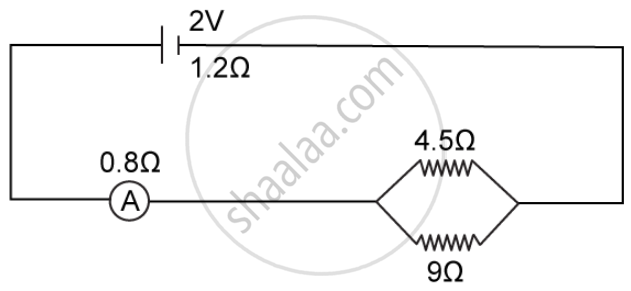
Find:
- The reading of the ammeter,
- The potential difference across the terminals of the cells, and
- The potential difference across the 4.5 Ω resistor.
What is the colour code for the insulation on the earth wire?
Four cells, each of e.m.f. 1.5 V and internal resistance 2.0 ohms are connected in parallel. The battery of cells is connected to an external resistance of 2.5 ohms. Calculate:
(i) The total resistance of the circuit.
(ii) The current flowing in the external circuit.
(iii) The drop in potential across-the terminals of the cells.
When a resistance of 3Ω is connected across a cell, the current flowing is 0.5 A. On changing the resistance to 7Ω, the current becomes 0.25A. Calculate the e.m.f. and the internal resistance of the cell.
(a) Calculate the total resistance across AB.
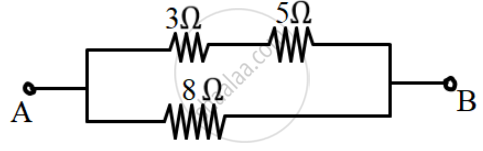
(b) If a cell of e.m.f 2.4 V with negligible internal resistance is connected across AB then calculate the current drawn from the cell.
Explain the meaning of the term internal resistance of a cell.
