Advertisements
Advertisements
प्रश्न
88 cm3 of nitrogen is at a pressure of 770 mm mercury. If the pressure is raised to 880 mmHg, find by how much the volume will diminish, the temperature remaining constant.
Advertisements
उत्तर
V = 88 cm3
P = 770 mm
P1 = 880 mm
V1= ?
T = T1
Using gas equation,
`"PV"/"T" = ("P"_1 "V"_1)/"T"_1`
`(770 xx 88)/"T" = (880 xx "V"_1)/"T"`
V1 = 77 cm3
Volume diminishes = 88 - 77 = 11 cm3
APPEARS IN
संबंधित प्रश्न
Explain Charles's law on the basis of the kinetic theory of matter.
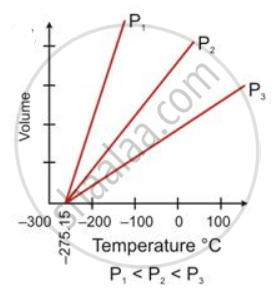
State the law which is represented by the following graph:
Give reasons for the following:
Mountaineers carry oxygen cylinders with them.
State the following:
Ice point in absolute temperature
2 liters of gas is enclosed in a vessel at a pressure of 760 mmHg. If the temperature remains constant, calculate pressure when volume changes to 4 dm3.
Calculate the final volume of a gas 'X' if the original pressure of the gas at STP is doubled and its temperature is increased three times.
Correct the following statement:
The volume of a fixed mass of a gas is directly proportional to its temperature, pressure remaining constant.
Fill in the blank with the correct word, from the words in option:
If the temperature of a fixed mass of a gas is kept constant and the pressure is increased, the volume correspondingly _______.
A fixed volume of a gas occupies 760cm3 at 27°C and 70 cm of Hg. What will be its vol. at s.t.p.
The pressure on one mole of gas at s.t.p. is doubled and the temperature is raised to 546 K. What is the final volume of the gas ? [one mole of a gas occupies a volume of 22.4 litres at stp.]
